Dominique, thank you for finding time. Let’s start. What are your key insights about Ukraine and what did you think about Ukraine before you met the country?
I didn’t know so much about Ukraine before because I didn’t know it. I remember talking to the headhunter who hired me in 2019 to move to Kyiv. And he was, like: “Do you know Ukraine?” I was like: “No.” And then he asked me: “Do you want to know about Ukraine?” I was like: “Not really.” And then he was like: “No, no, but look, I mean, in tech we’re really good. We’re doing a lot of things. You should come and visit.” And then I just said: “Well, you know what? I will come and visit”. And basically, I never left. I came and visited, I accepted the job and I moved to Kyiv.
And that’s really my feeling about Ukraine. Of course with the war, it’s more than that. But people don’t know about Ukraine. People don’t really know about the country, people don’t really know that Ukrainians are amazing in tech. People don’t really know that it’s one of the biggest agricultural countries in the world. People don’t even know that it’s the largest country in Europe. And people don’t know the cities in Ukraine. Nowadays if you talk to people about Mariupol, they’re gonna know, but for bad reasons. Not for the good reasons. You know what I mean? So before I knew it, I knew not much. What do I know now? First, I know about the people, which is something I didn’t know before. And I really, really love the people in Ukraine. I love the culture. I love where we work. I love the generosity. I love the way people hear their moves, where you go, you’re invited somewhere and you have a table full of food that you share with everybody and it’s a culture of generosity and I really like that.
The second thing I love is the energy. The energy in the country. That is something absolutely amazing and that makes you feel good, that makes you want to do things. Especially in tech, people are very passionate, very passionate about what they do and they’re extremely good technically, but they’re also very passionate. And that passion plus technical excellence equals a lot of energy. And a lot of energy with not a lot of money, equal ways to do things that are very original. Not always, I mean not always what we would do in Silicon Valley for example, but so much more efficient. It’s so cool and so much more creative. And I would say the certain thing is creativity and it’s something that I think people don’t really know about Ukraine but just look at the designers. Just look at the fashion, just look at the art, just look at the music scene. I mean now we’re starting to discover all those music bands that are incredibly creative and I think this is for me, this is something that fuels me, energy plus creativity that makes me happy. And so at the end of the day it’s a place where I’m happy. And I can feel it. Right now I’m in Ukraine and even though it’s not a great moment to be in Ukraine because of drones and bombs all the time, but I’m not scared and I feel the energy. I’m just happy but it’s so strange.
It was a great answer. Thank you. Yes, you’re right. You’re absolutely right, especially about the energy. Our second question to you will be about your main observations when you started working in Ukraine. What were they?
So as you probably know, I was the CEO of Unit City and I was the only non Ukrainian in the entire company. I really started working in Ukraine. Like I mean of course everybody more or less spoke English, but I arrived in a company where I was the only non Ukrainian. So I fully emerged in the Ukrainian way of doing things and the first thing that struck me was the passion. And the fights. There were so many fights, like people arguing all the time: “No, this is the way to do it.” “No, you’re an idiot. This is the way to do it.” But you know at the end of the day it worked. We always found a decision and to me, in many ways that was very French, because French people tend to do things the same way. We argue a lot. We find the reason why it’s not going to work this way and the reason why you should do it this way. But we always start with why this is not going to work. That’s not exactly the case in Ukraine. In Ukraine, you want to make it work, but then you fight on how to make it work. In France, we start with why this is not going to work and you try to make it work. So the challenge is different. But at the end of the day, why should you fight? And that was very different because you know in the US we have a culture of consensus and everybody’s nice. When you say oh it’s awesome — it’s really bad. But it’s awesome. It’s so good. And then in fact it’s really bad. That’s not the way we work here, we really say what we think and then we try to make it work. The second thing, I’ll say it once again, it’s a passion. People are really passionate and they are passionate and just struggle so it goes in the same way. Nothing is completely easy because each time you’re trying to do something, in a lot of cases it’s the first time you’re trying to do this, especially in innovation and tech. I remember we had tons of conversations about drone delivery. We wanted to experiment drone delivery and never done it before and had a lot of conversation about the government, about the city. And I love this because at the end of the day we try to make things work and I think that’s it.
I would like to ask you about your initiative, about your activities, especially about a Team4Ukraine. Could you please tell us more about the project? What were the difficulties here? And how long do you have it?
We call it the Team for UA. So Team for UA is a nonprofit that was started by a good friend of mine, Jean Cristoff Bernice and I joined the team about a month and a half after he started it, so very early.
We started with and we keep doing it with humanitarian help. So we’re delivering food to the Gray zone every day. We have 150 people in Uman in the warehouse and we are delivering food in the Gray zones, so from the frontline to 30 kilometers inside. All along the front line we are now the biggest partner of the world program doing this and our only goal is to stop this. But we don’t want to do this. We do it because we know we have to do it. But ultimately worse, this is not something that we want to do.
But we had to do it and we had the logistical experts in our team to help us. But very early we said, look, both Jean Cristoff, my cofounder, and me, we come from tech. He’s a tech entrepreneur, I’m a tech entrepreneur and we said okay, how can we bring tech in the reconstruction of Ukraine? And very quickly stuff down a few companies that are doing 3D printings for building. And he thought it was a good idea and I came from the Unit with an expertise in building in my brain, I said: “I love it. I think this is exactly what we’re gonna need.” And when you see the numbers of houses being destroyed, schools, you’re like: “Okay. We have to find a way to use technology to build faster, cheaper, greener, using everything we can find in Ukraine.” And this is why we decided to start. We are currently printing our first school. It’s in Lviv. It’s a public school. We’re donating the school to the city of Lviv and it’s going to be the biggest 3D printed school in the world.
And we decided to work only with Ukrainians. So the Belbeck Bureau and Slava Belbeck designed the school and he was very excited because this is the first 3D printed building in Ukraine. So nobody has the expertise to do this. Nobody has done this before in Ukraine. We worked with an engineering team from Ukraine and we’re currently training a general contractor from Ukraine — 7CI. We know them because in Unit they have Pro PM which is a training school for project manager for construction. And what I love about 7 CI is that the manager is a women. So it’s a woman manage the company — Olga, and CEO is on site every day. She’s working with us and she brought our team to learn how to do this, so we can scale. So this is our first project. This is a pilot, we’re learning a lot from it. It’s super challenging and, to be honest, everything is challenging because it has never been done before. So we’re learning so much about how to create the recipe for the cement, can we find the local chemicals, sitter, etc. But even the permit is complicated because nobody knows exactly what is it. It’s never been done before. Since it has never been done before, nobody knows how to test it. How do you decide on the foundation? Nobody really knows. So we had to go through all those challenges. We got lucky working with the city of Lviv because they were willing to take the risk. But it’s really cool. The next step is we’re printing a bridge because we can’t bring buildings, but we can also print bridges and we’re doing that with the Ukrainian government, the Ministry of Infrastructure and it’s going to be in the Kherson region. So that’s our next project – a 15 meters long bridge. Once again, it has never been done before, but if you can do, for example, the school, we can print it in a week. This one it’s the first one. So it’s taking us three weeks, but we can print the full school in a week. 500 square meters. You know what I mean? That is so impressive. So it’s 10 times faster than the regular building. If we can buy the right printer, which costs about 1.5 million, it’s expensive, we can build up to an 8 stage building. And it’s 10 times faster than anything else. And it’s really cool because you can print the foundation, you can print the floors, then you can print the roof. You take a crane, you put the roof on top of the building. I mean, it’s really, really cool. So I’m super excited about it and actually seeing it on site now. As you can see, I’m wearing my t-shirt to go on the ground. And then we’re printing. We were printing until 10:00 PM last night, but we could print all night. Yeah, you can print 24/7. You just need two people. You just need someone who takes care of the cement and you need a guy with a computer who’s just making sure that the printer does its job so you can print 24/7. It’s great. It’s crazy. It’s really great. But every day I’m watching the print and I’m like okay, that’s cool. That’s very cool. So that’s what we’re doing with Team4UA. And our biggest challenge, like every nonprofit has, is to raise money. Honestly, it’s the most difficult. And that’s why we’re very excited to have this pilot project now, because with the pilot we have something real to show. To see we can do it. So we found enough donors for the first phase, but now we have to find more people, I mean, more runners.
And this is a real revolution in this building industry. That’s crazy. And you know, this is what I’m doing. This is what I love. I don’t like to do things that have been done before. So a lot of time you try doing things that I’ve never done before and it doesn’t work. But if you don’t try, you don’t know, but you know it’s like you need a city. I mean something that scale has never been done before. And that’s really what I love and that’s something that I love about Ukraine as you willing. As a country, we are willing to take those risks to try what has never been done before. And it’s really hard in Europe to find a country that is willing to try things that have never been done before, like in France. I remember I’m going to tell you strikes, but I have to tell you that story. I met the French Minister of Digital Transformation, Jean-Noël Barrot, Nataly knows him because she met Jean-Noël in Paris. I met him at the Web Summit in Lisbon. And I told him: “You have to look.” And it was before Diia was everywhere, like Diia was in DC last week. Diia is in Estonia now. I told him: “You have to look at these things. Diia, it’s amazing in Ukraine. We don’t have this in France.” He’s like: “You know French people, they will never want it. And what about the data and the privacy?” And I like: “Dude, you at least look at it.” And now it’s going to be exported in London. I love Ukraine because of those things. I love Ukraine because of Dia. I love Ukraine because of 3D printing of school and everybody’s excited about it and that’s cool.
I would like to ask you about your vision of the development of Ukraine after the war. Could you please share your insights about it?
Look, I’m very, I’m very optimistic about this. I really think that after the war, Ukraine is going to be the place to be. I’m serious. In Europe, I think it’s going to be the place to be. Look at it, and look at what Ukraine can bring to Europe. With Ukraine, Europe becomes the largest agricultural country in the world. And it’s impossible without Ukraine. I mean, we need agriculture. It is a power of Ukraine, which is already one of the largest agricultural countries in the world. But imagine Ukraine in Europe. Bringing this power to Europe. That was not the case when we integrated the other Eastern Europe countries that were much smaller, much less powerful. Now let’s talk about the technology. In many cases, people tend not to know it. But we have the tech talent. We have a tech system. We have a lot of unicorns now, we have the energy. And we’re going to have money, because a lot of money is going to come to Ukraine to help for the reconstruction.
So I’m very optimistic and I’m very pushy on what’s going to happen after. That’s why I’m creating the Phoenix Tech Fund because a lot of people are telling us you guys are crazy. You want to invest in an early stage startup in Ukraine during the war and you’re a first time fund manager which is equal going to fail. I mean in people’s minds it’s like too many risks and I’m like: “Dude, but we see the vision. I see the path. I see where this is going and we need to create an early stage ecosystem in Ukraine for tech.” And we’ve been lacking from an early stage for years and years and we know it because we don’t have a culture of early stage investment. We don’t have a culture of Angel investment.
And it’s changing slowly, it’s changing, but by bringing a significant size fund, I mean 50 million is not huge, but I think it’s the right size for a first fund and then others are going to come. And I’m super optimistic about what’s going to happen next. I think it’s going to be an amazing time.
Okay and what interest exist from the Western businesses? Do you see some of them?
You know it’s really interesting but it’s something I keep saying and I don’t understand why. I think the Americans understand very well how to do business in Ukraine. And I I don’t think Europeans know Ukraine very well. So once again, I mean when we talk about tech, 90% of the money invested in Ukraine comes from the US. So where are the Europeans? And that’s something that concerns me a little bit, it’s European, and I’m not super business focused.
And the Americans are seeing the opportunity. I have two passports. I have a French and an American one. So I can do whatever I want depending on who I’m talking to. But usually I have a little bit more European and I feel like we’re missing. I mean we have resources, we have an amazing land. And not only the land, but what’s underground: the mining, the etcetera, the resources we have. We need people to come back. And my only really big concern is people not coming back. We need talent and the demography of Ukraine is not great. And to me, this is going to be one of the biggest challenges of the country after the war. How do we convince people to come back? It will be a challenge for us. But this is exactly by creating business opportunities and by actually like the things that we are doing with the Phoenix fund. It is about creating business opportunities. If it will be interesting in Ukraine, not only Ukrainians will come back, but international talent will also. I hope so.
Dominique and what about Viva Tech? How did it happen that Viva Tech provide Ukraine with the free pavilion? Could you please comment on it?
So it’s a fun story. It happened last year and as you probably know, I’m the president of the French Tech in Kyiv, which actually we created. So we created French Tech four and half years ago. And actually it came to us through a very discreet guy that I like very much. His name is Jeremy Altayed and he works for the French Minister of Foreign Affairs. And it’s interesting because on the back of everything we do as Viva Tech, is the French Minister of Foreign Affairs who is actually convinced be that tech to give us a free booth. So basically I had nothing to do, I just had to say: “Yes.” But Jeremy called me and said: “Look, don’t say it’s the French Minister of Foreign Affairs, we don’t want to be too visible, but the event has agreed to give Ukraine a free boost pavilion with my dear friend Diana Sidko who is also on the board of the French Tech chief.”
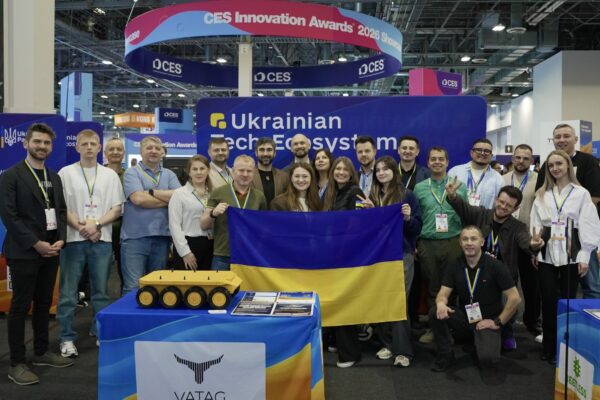
We were able to bring a group of people like you guys together and Ukrainian startup fund and everything to create the booth to spell like startup and I think it was super successful. We met with President Macron, we had the press and, you know, it was pretty early, during the war, like it was in June and the war started only in February. So I think it was also very good for the Ukrainian technological system too. Being together abroad for the first time. It was not the first time but it was one of the 1st and that was great. And this year they asked us and actually they asked the Ukrainian embassy in France first. “Okay guys you want to do it again. We’re willing to do the same deal as last year and here we go.”
An honest thing that comes from me, it comes from the Minister of Foreign Affairs and I just pushed the initiative by pushing in the right way. To me tech is important. Is it as important as Web Summit or London Tech Week or TechCrunch? I don’t know. I’m not sure. But what I know is it is very important that the Ukrainian tech ecosystem comes together as a community in those places. To show that we are united, that we are fighting together, that it’s not just about us individually, but it’s also about us as a community. And it’s also pushing the message that Ukraine is a strong tech country and I think that is a game changer. That is something that people are now seeing that we are a really strong great tech country. I think it was amazing to see it fed off on stage at Web Summit. It was really cool. I was super happy with that because I think this is selling the right part of Ukraine. You know what I mean. Remember that before, before we’re trying to bring Storm on how to pitch TechUkraine. How to pitch Ukraine. I mean, well, I mean now it’s done and the job is done and people know we’re good in tech and you know, now we need to iterate for the next phase by the come invest in Ukraine, in tech, you know come work with us. But the first phase, now it’s done. So I’m super excited about those initiatives. I think they’re very important. But by the way, we plan to update this project on how to pitch Ukrainian tech with new messages, because now the reality has changed and we also need to adapt to what we’re going to say next about the Ukrainian tech system.
And the last question is, Dominique, please tell us what are your plans for the future and do you connect your future with Ukraine?
Oh yes, my future is Ukraine. Well, I mean I’m going to be full time involved in the Phoenix Text Fund. So I’m managing the fund. So I’m the one leading it. So I’m going to continue working with Team4UA because I’m very passionate about this initiative and I want to fundraise for it. Starting soon, as soon as the fund is set up, which is in a few months, I will spend four weeks in the US, 2 weeks in Ukraine, four weeks in the US, 2 weeks in Ukraine, and then we will see how we can rebalance. I don’t know if I’m going to move full time because as you know, I have the baby. He’s not a baby anymore, he’s turning 10, but he’s super happy in the school right now and I think it’s not completely fair to him to move him again so we’ll see. But my dream is to move back full time to Kyiv. That’s my goal and my dream. I was there last weekend. I’m like well this is home. I mean I go on the street, I know people, I see my friends have dinners, and I’m like oh I love it. And I bought the super cool jacket and this is home. And I got sushi at TSUM. This is my favorite. The sushi at TSUM. So anyway, I miss Kyiv a lot, actually, a lot.
My future is Ukraine. Sounds amazing. Thank you. And we are very grateful for the interview and for your time.