

As the war in Ukraine casts a long shadow, its devastating impact on the nation’s energy infrastructure paints a stark reality for the approaching winter. Targeted attacks have plunged communities into darkness, and the specter of a cold, harsh season looms large.
In this critical interview, Roman Zinchenko, co-founder of Greencubator, reveals the depth of the challenges facing Ukraine’s energy sector. He confronts the grim consequences of lost generating capacity, the vulnerability of centralized systems, and the urgent need for a resilient and sustainable energy future.
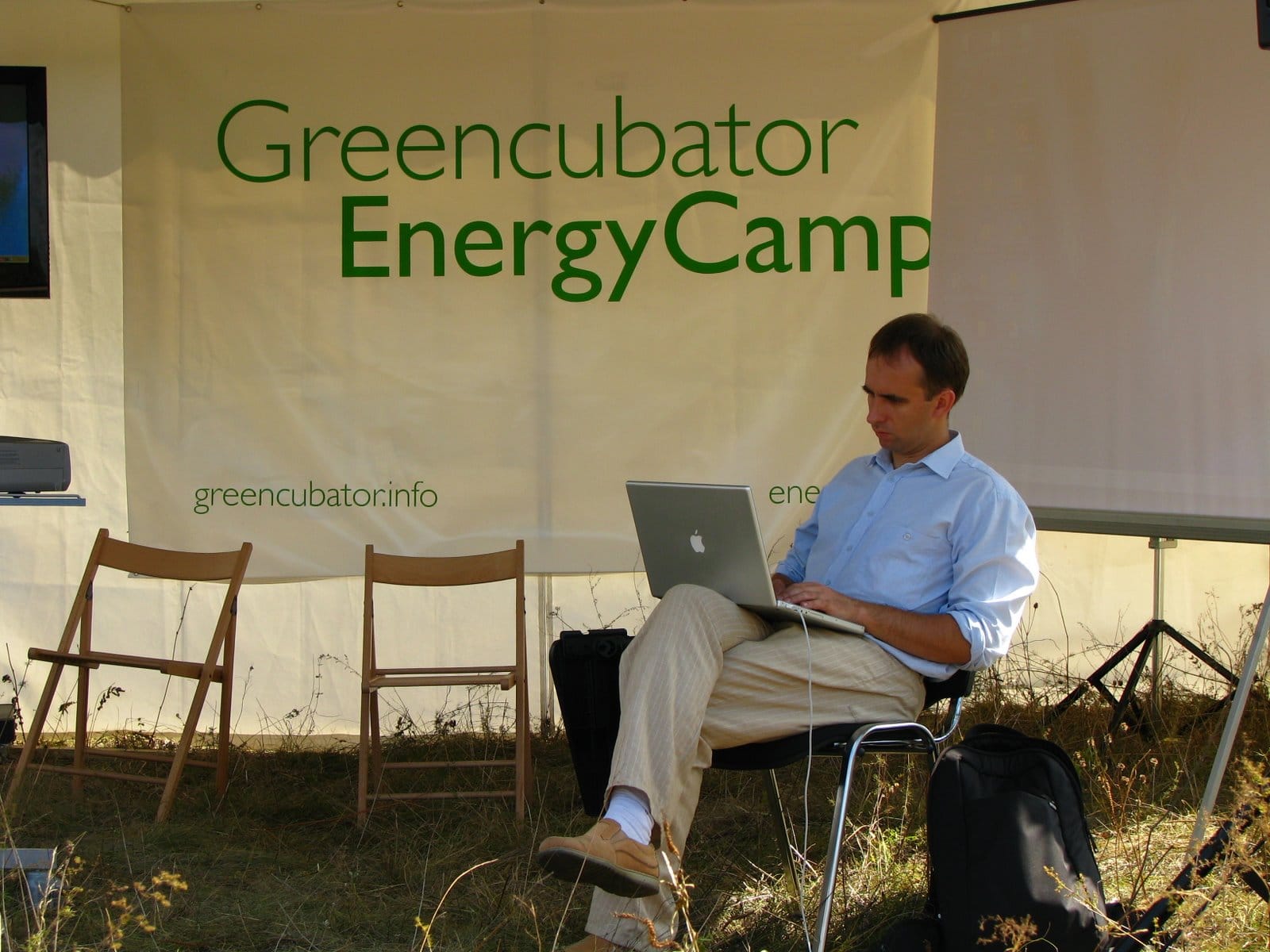
Yet, even amidst these trials, Zinchenko’s words resonate with hope and determination. He envisions a path forward, powered by decentralized energy solutions, empowered prosumers, and the unwavering support of the global community.
Key takeaways from the interview:
- From Devastation to Transformation: Witness how Greencubator has adapted its mission in the face of war, channeling its efforts towards fostering energy resilience and empowering communities.
- Decentralization as a Lifeline: Explore the shift from a vulnerable centralized energy model to a decentralized, community-driven system that can withstand future attacks.
- Empowering Citizens as Energy Producers: Understand the transformative potential of enabling individuals and businesses to generate and contribute energy to the grid, fostering a sense of ownership and self-sufficiency.
- A Global Call to Action: Recognize the crucial role of international collaboration in rebuilding Ukraine’s energy infrastructure and creating a model of sustainable resilience for the world.
Part 1: Personal Journey and Greencubator’s Mission
Interviewer: We’d love to learn more about you and Greencubator. What’s your personal experience and motivation for working there? What’s Greencubator’s mission and main strategic goals?
Roman Zinchenko: Interestingly, about a third of my life is connected with Greencubator. This year, it turned 15. My brother and I founded Greencubator with the aim of supporting the emerging green innovations and new energy solutions sector. Over the years, we’ve also added new segments and initiatives primarily focused on climate innovations.
Currently, Greencubator focuses on supporting companies that grow the green GDP of Ukraine. These companies create innovative products in the climate innovations and sustainable energy sectors, both domestically and internationally.
Since 2009, we have evolved from a non-profit seeking grants to one also distributing them. We manage several grant-based innovation programs, including the EBRD-EU program “Climate Innovation Vouchers”, one of Ukraine’s largest grant schemes for innovators in green and climate-friendly technologies. . Likewise, we are partners with CIVIC, The Possible Consortium and thanks to their support we are able to provide micro-grants for supporting green social ventures. We have also just landed a new program supporting green SMEs, that includes grants and acceleration components, and will be announcing the official start this autumn.
Greencubator is fascinated by green innovations, innovators, and building communities. Networking events like EnergyCamp, TeslaCamp, our conferences on energy efficiency and sustainability were once our major projects. They became a popular meeting point for Ukraine’s emerging green industry, and we met many partners through them. While we no longer host these events, we miss them, and the industry does too. We’re connectors, networkers, knowledge disseminators, and explainers. Four pillars are crucial for Greencubator: entrepreneurship, education, community support, and policy innovations.

We’ve also undertaken educational projects. In 2021, we launched Greencubator. Academy, an online platform that helps Ukrainian eco-innovators develop their ideas into sustainable businesses.
We support Ukrainians in launching and growing their startups through acceleration projects and international competitions. For example, Greencubator has been hosting the national stage of the ClimateLaunchpad green business idea competition since 2016, with numerous Ukrainian cleantech companies graduating from the program.

We’re proud that in 2023 alone, our grantees and alumni raised over 12.8 million euros in grants and investments. This is impressive as the industry is still relatively new in Ukraine, and these companies are actively taking on global markets.
Interviewer: That sounds really impressive.
Part 2: The Birth of Greencubator
Interviewer: Can you share a bit about your personal background and why you created Greencubator? What was the initial motivation?
Roman Zinchenko: The initial motivation was simple: my brother Andriy and I were bored with the industry events around the energy sector. That we got interested. And our interest grew from Crimea. We saw the abundant solar resources that people there didn’t utilize and wanted help using this resource. We also saw the dangers of dependence on russian energy.

My background was in communications, including financial PR and investor relations. I worked for Ukraine’s first venture capital firm, Aventures, and later ran my own financial communications boutique. My brother Andriy pioneered infographics and 3D animation in Ukraine. His company created a new market for explainer videos in Ukraine, and major national TV channels were among his clients.
Then the 2008 crisis hit, and all our markets collapsed. Despite the challenges, we still had knowledge, energy, and ambition to create something new.
We thought our experience in communications and investor relations could help the emergence of the green energy sector in Ukraine. However, we needed a well-structured organization to help shape a new idea of wealth: green wealth, green GDP for Ukraine. That’s how Greencubator came to life, and it has already been for 15 years.
 Interviewer: It’s proven to be very successful. Greencubator has a tremendous impact on green energy in Ukraine, and globally, from what I know.
Roman Zinchenko: Thank you. Your words mean a lot.
Part 3: Impact of the War and Greencubator’s Adaptation
Interviewer: The war in Ukraine has been ongoing for years, escalating in 2022. How did the full-scale invasion affect Greencubator? Were there changes since 2014, when Russia first invaded Eastern parts of the country? How is Greencubator adapting to the challenges Ukraine faces now?
Roman Zinchenko: When the war started in 2014, we felt it as a shock and also as proof that russian energy is a weapon. Many of our friends and partners lost homes and businesses, while Ukrainian defense forces were deterring this creeping invasion. Some of our partner universities were relocated, and we lost the ability to work in Crimea. We hope to return there someday.
In 2022, the full-scale invasion was a manyfold bigger shock for everyone. Our team responded by volunteering for Ukraine defense forces, procuring and delivering the much-needed personal protections and communications equipment for our defenders. This led to establishing the Group 35 charity fund, where our team was the operational core during 2022. Some time later I turned to individual volunteering efforts, primarily focusing on helping air defense units. In 2024, we teamed up with the Gurkit fund, fundraising for 10 fully-stocked pickup trucks for air-defence anti-drone units.

Surprisingly, the cleantech market rebounded quickly. In 2022, I was grateful to our team for keeping operations running while I focused on charitable activities. And the team did a great job! We had impressive results, doubling the number of application on our key projects.
We had to freeze activities initially, but then decided to continue while also volunteering. In August 2022, we held a dual bootcamp for ClimateLaunchpad due to the high number of excellent applications. The market was active and dynamic.
Russian attacks on Ukraine’s energy infrastructure show that our businesses and communities have to increase their energy resilience. That is why we are working on projects helping SMEs and communities navigate intermittent power.
Since February 2022, Ukraine has lost over 9 gigawatts of generating capacity, a tough burden on the economy. As Russia aims to stifle Ukraine economically, we must support companies struggling from power cutoffs or production losses.
Economic recovery, energy recovery, and building forward are our ambitions. Greencubator dreams of creating a sustainability-focused impact fund to support climate and energy innovators. That’s the next chapter of our work.
Interviewer: That’s a big dream.
Part 4: Energy Crisis and Green Technology Solutions
Interviewer: Greencubator is well-positioned to address the energy challenges caused by Russian attacks. Centralized generation is vulnerable. Could peer-to-peer green energy generation help? What are your thoughts on the energy crisis and specific technologies that can help? What projects exist in Ukraine that can be scaled up? What barriers hinder green technology and decentralized networks? What steps should the government, businesses, and civil society take to accelerate the transition?
Roman Zinchenko: The Russian attacks on Ukraine’s energy infrastructure are destructive, but they also drive a shift from the Soviet hyper-centralized model to a decentralized, resilient model of generation and distribution.
Previously, transformations were blocked by a simplistic approach to customer protection, leading to subsidies and demotivating energy conservation. The attacks have forced necessary reforms in generation, distribution, and connectivity fees.
Now we’re facing a new era for Ukrainian energy. The sector was perceived as oligarchic and feudal, but the landscape will change within five years. New players will enter, creating a more bourgeoisie-type market.
Since 2022, many new players not previously involved in energy have announced their entry into the market. In addition to major business groups, state-owned companies like Ukrainian Railways are developing their energy generation capacity. Their electricity grid is larger than in some countries, and they have the skills to manage electricity flows.
This transformation of the power generation system significantly benefits the country’s population and economy. Decentralized systems are a more complicated target for Russian air attacks, and smart grid technologies have self-healing components. But even more, Ukraine can rebound as a major European electricity supplier. Exporting green electricity can be a national idea, accessible to households, SMEs, and large companies. That is why Greencubator works on new projects to promote smart grids in Ukraine.
At the same time, Ukraine lags in consumer-facing innovations like behind-the-meter energy storage, demand-side response, smart metering, and energy consumption limitations. Power outages during electricity deficits are our rough reality. A potential solution could involve faster implementation of personalized home energy storage and smart meters, benefiting end-users.
End-users can become players in sustainable generation, while aggregators can integrate tier distributed energy resources (DER) to participate in the balancing market. To do that, we need a “Monobank of energy efficiency”, integrating financial services, behavioral change, and new technologies for the mass rollout of energy innovations. This would help consumers face shorter power outages and potentially become prosumers, generating electricity and contributing to the market.

Interviewer: It’s optimistic and promising. I agree, the market is transforming from a monopoly of several companies to a more open format.
Roman Zinchenko: We should also mention the unhealthy share of the state in the energy sector, larger than any private institution.
Part 5: Accelerating the Transition & Empowering Consumers
Interviewer: We need to accelerate the positive processes you mentioned. What should stakeholders do to facilitate this transition and enable local consumers to not only consume energy but also generate and sell it to the grid? This would be more sustainable than buying generators. We need enough electricity for the winter, but our long-term goal is to open up and democratize the market. What roles do you see for the government, local and international civil society, and other groups to achieve these goals?
Roman Zinchenko: There are several critical activities to move forward.
First, we must enable infrastructure development to help the grid absorb all available kilowatts from the variety of energy sector players, large and small
Second, we need our energy regulator to actively support local and peer-to-peer generation, allowing prosumers to help power their neighbors when the grid can’t.
Finally, everyone needs education on energy resiliency and protection against power outages.
Technologies for such energy breakthroughs already exist, so Ukrainians need more access to finance. We need regulatory and financial innovations, like loans, credits, and leasing models, to allow households and SMEs launch their energy storage and distributed generation.
This year, I’ve invested in energy resiliency solutions for my home. For example, I installed an inverter and batteries kit for my apartment. Next, I’m considering expanding my battery bank and installing a balcony solar array. I am also preparing to invest in backup heat supply, although it is quite expensive.
Energy sources diversification is also essential, so I have an idea of switching back to gas for cooking to reduce dependence on electricity.
The large part of middle-class Ukrainians have already invested thousands of dollars per household to maintain their comfort, connectivity and personal energy security. However, the lower-income part of the Ukrainian population still need access to financing and social support programs to keep the lights on and homes warm.
Interviewer: Programs exist to compensate up to 75% of generator costs for communities. Could we promote similar compensation for sustainable solutions like batteries, inverters, and green generation? This would be more sustainable than generators. Is this happening?
Roman Zinchenko: Subsidies are working. Municipal programs and the Energy Efficiency Fund offer support for energy audits and solar installations. However, regulations don’t offer support for apartment co-owners like me to invest in solar.
Interviewer: Can individual solar owners sell energy to the grid?
Roman Zinchenko: They can, but there are still limiting regulatory issues, and persistent payment delays for those supplying electricity with the feed-in premium contracts.
Part 6: Global Involvement and Business Opportunities
Interviewer: How can the international community be involved in resolving Ukraine’s energy situation? Do you see business opportunities or other forms of support?
Roman Zinchenko: While humanitarian aid is important, there are also huge opportunities for Ukrainian and foreign business. The energy sector is attractive for new electricity suppliers, especially those providing auxiliary services like frequency stabilization.
Lowering entry barriers will make the market even more attractive. There’s potential for startups in energy aggregation, smart grids, behind-the-meter storage, and financing. I actually believe financing plus rapid deployment is a major opportunity for new companies.
Part 7: Contact and Call to Action
Interviewer: Can anyone interested in these opportunities contact you or Greencubator?
Roman Zinchenko: Yes, email hello@greencubator.info, and it will reach our team and me. We’re happy to explore new projects, opportunities and invite you to our programs. This autumn we will be launching new grant programs for green SMEs, so I encourage you to join Ukrainian green champions!.
Interviewer: Thank you for your work and ideas. I hope we’ll transform and be ready for winter. And thank you for the interview.
Roman Zinchenko: Thank you, and thank you for developing the Ukrainian tech ecosystem and keeping people connected.