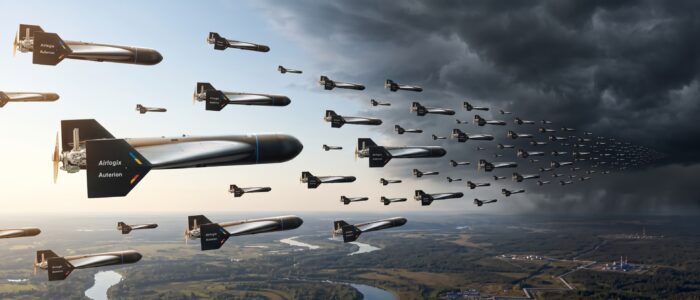
The rhetoric of the Munich Security Conference is transforming into a new industrial reality. The joint venture Auterion Airlogix GmbH has secured its first production order for thousands of autonomous strike systems.

This contract is the direct outcome of the agreements made during the Munich Security Conference in February 2026, supported by the governments of both Germany and Ukraine. It represents a transition into the industrial production phase, proving that the collaboration between Western technology and Ukrainian frontline experience can scale to meet European security needs.
Transitioning to Industrial Scale
The agreement, coordinated by the German Federal Ministry of Defence, marks a shift from tactical aid to high-volume manufacturing. The venture is set to produce thousands of systems per year on German production lines.
Production Hub: To ensure stability and meet export requirements, manufacturing is conducted entirely in Germany under Ukrainian export licenses.
Drone Configurations: The contract specifies the production of medium-range drones featuring both X-wing and delta-wing designs for the Armed Forces of Ukraine.
Strategic Intent: According to CEO Lorenz Meier, the contract proves that Europe is capable of acting on a large scale.
Technical Synergy: Software-Defined Defense
The partnership utilizes Airlogix airframes integrated with Auterion software, specifically for control, navigation, and swarm coordination.
The core of these systems is the Skynode S module from Auterion. This technology enables autonomous targeting, which was demonstrated in January 2026 during tests in the United States. During those trials, a single operator successfully managed a swarm of three FPV drones, engaging three separate targets simultaneously using “explosive-formed penetrator” warheads provided by Kraken Kinetics.

This autonomous capability is critical for bypassing electronic warfare (EW) interference, as the drones can finalize strikes without a constant manual link to the operator.
“Developed Under Fire”
The leadership of the venture highlights that these systems are not theoretical—they are the product of immediate necessity and combat evolution.
“Our engineers developed these systems under fire. Now, German industry is producing them at a scale that fundamentally changes the situation on the battlefield. Every unit rolling off the assembly line carries years of real-world combat experience”, stated Airlogix.
Why This Matters for the European Ecosystem
The Auterion Airlogix deal serves as a blueprint for the future of the European defense-tech base. It demonstrates a new model of cooperation:
Industrial Integration: Moving production to Germany ensures a resilient supply chain while maintaining Ukrainian intellectual property.
Scalable Autonomy: The focus on thousands of units per year addresses the need for “mass” in modern attrition warfare.
Future Standards: The data and operational performance of these autonomous systems will likely define the next generation of AI military standards across Europe.
The Bottom Line
As the first thousands of these autonomous systems move toward deployment, the message to the global tech and VC community is clear: The Munich agreements are delivering tangible results. Ukraine is no longer just a recipient of equipment; it is the primary R&D hub where the future of European security is being built and scaled.
Source: Militarnyi
UPDATE: Berlin Debut of the Anubis and Seth-X Strike Platforms
Following the initial announcement of the partnership, Auterion Airlogix GmbH officially unveiled the specific hardware resulting from this collaboration during a demonstration in Berlin. These platforms represent the largest German procurement of heavy autonomous strike systems to date, moving the joint venture into a new phase of strategic delivery.
Anubis: Strategic Precision at Scale
The Anubis is a medium-range strike drone designed for high-value targets. While its aerodynamic profile draws comparisons to long-range loitering munitions, it is fundamentally different in its intelligence layer. Powered by Auterion’s AI-driven terminal guidance, the Anubis can identify and engage strategic hardware even when GPS signals are completely denied.

The Anubis medium-range strike platform: Leveraging AI-vision for precision engagement in contested environments. Photo: Dev.ua
Seth-X: Tactical Response and Logistics Neutralization
For frontline operations, the Seth-X offers a more compact, rapid-deployment solution. It is engineered for precision strikes against light armor, infantry positions, and logistical nodes. Like the Anubis, it utilizes advanced swarm coordination, allowing a single operator to saturate an area with multiple units simultaneously.

The Strategic Shift
As CEO Vitaliy Kolesnichenko confirmed during the presentation, these systems are now entering the mass-production phase on German soil. This transition from the Gor reconnaissance platform to the Anubis and Seth-X strike systems completes the ecosystem: from battlefield intelligence to autonomous kinetic response.
For the European defense market, this is the first tangible proof that Ukrainian battlefield agility, when paired with German industrial capacity, can produce at a volume that redefines regional security.
Source: Dev.ua