For decades, Western defense procurement prioritized scarce, multi-million-dollar precision assets designed for low-intensity conflicts. The realities of modern attrition warfare across Eastern Europe exposed the critical flaw in that doctrine: precision without volume cannot sustain frontline superiority or deter aggression. Addressing this strategic deficit requires a new paradigm – software-defined warfare produced at an industrial scale.
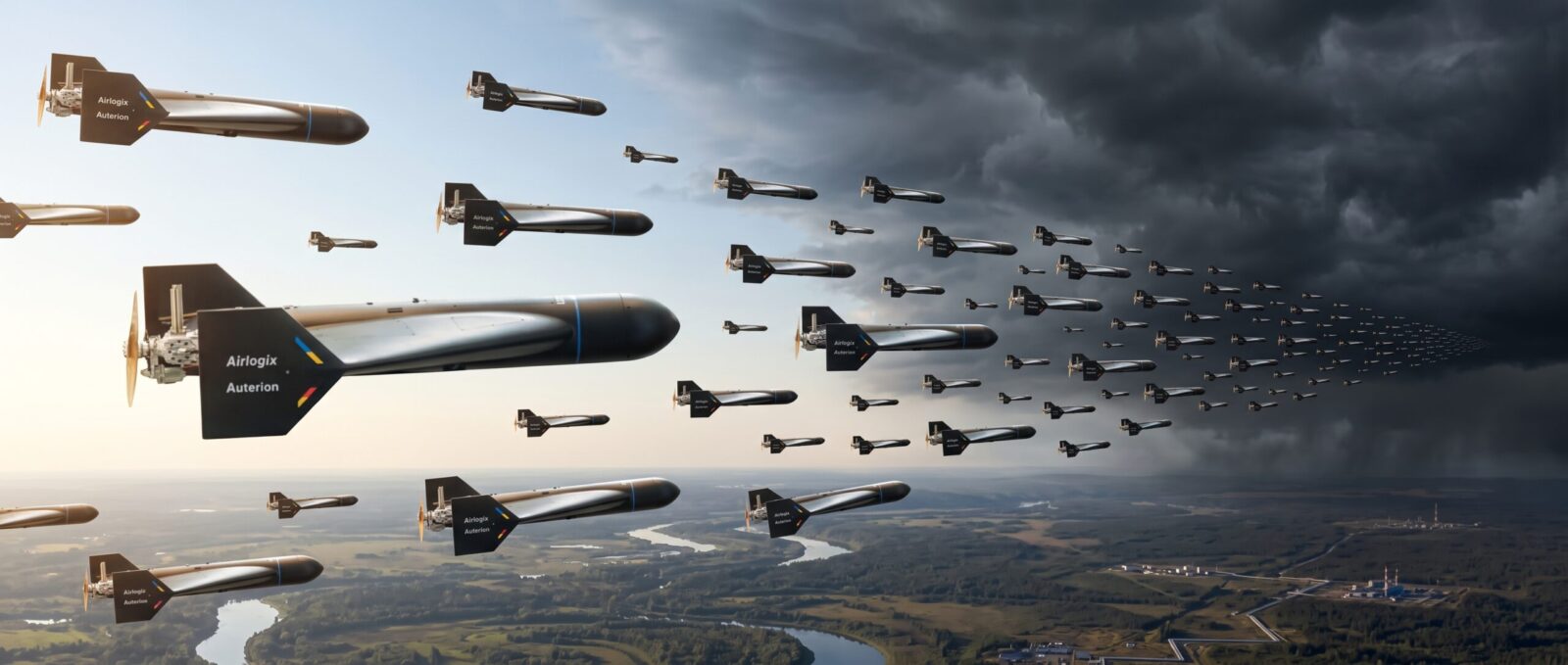
Bridging this gap, German-American autonomous systems software pioneer Auterion and Ukrainian defense manufacturer Airlogix have officially launched serial manufacturing of over 5,000 long-range combat drones for the Ukrainian Defense Forces.
The initiative is moving rapidly from bilateral rhetoric to heavy assembly lines. Initial units have already rolled off production floors in the Munich metropolitan area, as reported by German business daily Handelsblatt, citing company leadership and industrial sources, and covered by dev.ua. Backed by the German federal government, the contract carries an estimated valuation of approximately €300 million, with full fulfillment projected through mid-2027.
Deep Strikes and Dual Architectures: Technical Parameters
The bilateral cooperation established between the companies focuses on combining sovereign airframe hardware with an advanced autonomous software stack:
Hardware & Airframe Architecture: Airlogix directs the airframe engineering, aerodynamic configurations, and core hardware design.
Autonomous Operating Layer: Auterion integrates its specialized operating system, onboard mission computing, and electronic warfare – resilient navigation software.
Deployment Profiles: Manufacturing encompasses two core strike models:
Medium-range loitering strike systems.
Deep-strike platforms engineered to reach operational ranges of up to 1,500 kilometers.
Both variants integrate artificial intelligence modules engineered for terminal guidance. This capability allows the platforms to lock onto target coordinates autonomously, bypassing severe GNSS-jamming and spoofing across contested operational theaters without relying on continuous pilot telemetry.
Addressing the scale of the rollout, Auterion CEO Lorenz Meier emphasized the strategic industrial inflection point:
“Germany now has a production line for the manufacture of affordable, high-precision weapons in large quantities. Later this year, we will be supplying tried-and-tested systems – at a cost and production rate that genuinely enables the creation of large stockpiles for deterrence”.
Airlogix CEO Vitaliy Kolesnichenko reiterated that the partnership leverages frontline adaptability backed by continental manufacturing depth:
“This partnership unites Ukrainian technologies, proven in real-world combat conditions, with Auterion’s autonomous software and the industrial capacity of the German defense sector”.
To scale output beyond the Munich hub, the joint venture is also preparing to stand up an additional manufacturing facility in Eastern Germany.
Context & Retrospective: The Auterion Airlogix Architecture
The current €300 million order is the direct scaling phase of an industrial joint venture formalized following the Munich Security Conference in February 2026.
As TechUkraine analyzed earlier this year in our comprehensive field report, From Munich to the Frontline: Auterion and Airlogix Scale Autonomous Drone Production for European Security, the establishment of Auterion Airlogix GmbH laid the groundwork for an integrated European defense supply chain operating under Ukrainian export licensing.
Several technical cornerstones established during the joint venture’s inception inform the current serial run:
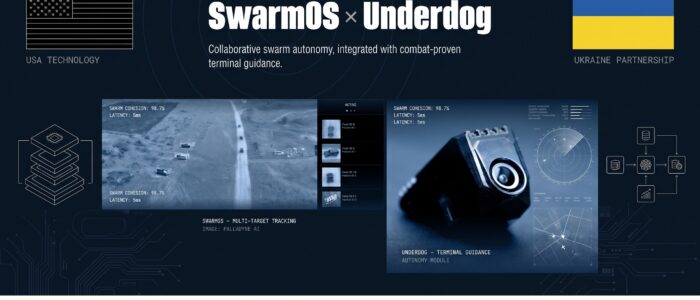
The Skynode S Hardware Nexus: At the computational core sits Auterion’s Skynode S, an onboard avionics computer explicitly engineered to deliver machine-vision terminal guidance. Demonstrated in US test ranges in early 2026, the architecture validated synchronized swarm management, enabling single-operator multi-target engagement using specialized kinetic payloads.
Combat Heritage: Airlogix transitioned from tactical battlefield reconnaissance – pioneered with its proprietary Gor UAS platform – into hard kinetic platforms engineered specifically under electronic warfare saturation.
The Anubis & Seth-X Foundations: Unveiled in Berlin earlier this year, the medium-range Anubis (engineered for deep precision against strategic assets under denied GPS) and the tactical Seth-X (tailored for perimeter logistics and armored neutralization via coordinated swarm dynamics) established the physical blueprints now entering full manufacturing cycles.
Strategic Implications for the European Defense-Tech Ecosystem
The Auterion-Airlogix serial manufacturing contract establishes several critical precedents for Western defense procurement, venture builders, and sovereign investors:
Intellectual Property Meets Capital Scale: Ukrainian defense startups are no longer limited to domestic capital or emergency state grants. By securing co-manufacturing rights in Germany, Ukrainian R&D directly unlocks Western institutional balance sheets without sacrificing IP or strategic agency.
Solving the Cost-to-Defeat Ratio: High-volume serial production lines capable of delivering 5,000 attritable precision units at a fraction of legacy missile costs fundamentally recalibrate deterrence economics along NATO’s eastern border.
Establishing Standardized AI Protocols: Deploying thousands of autonomous strike systems in contested airspace establishes the primary real-world performance baseline for military AI standards across the continent.
As the first units move from assembly lines toward active operational theaters, the defense corridor between Munich and Kyiv has delivered a working operational template: modern mass is software-defined, modular, and built on cross-border industrial integration.