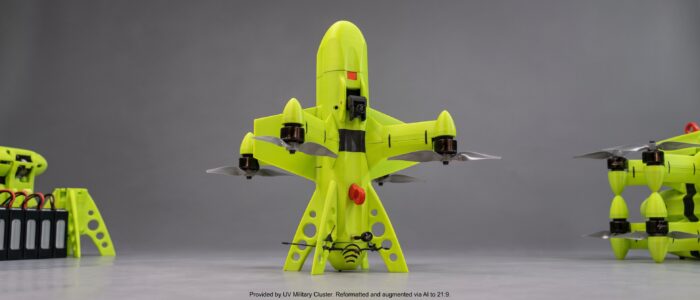
The Ukrainian defense technology sector is not just adapting; it’s innovating at an unprecedented pace, particularly in unmanned aerial systems (UAS). Two significant developments underscore this momentum: Aviation New Technologies (ANT) has rolled out its fully Ukrainian-made MERCURY VTOL reconnaissance drone, already battle-tested and NATO codified, while Skyeton is strategically scaling its Raybird production within the EU, cementing its European foothold.

ANT MERCURY: Forged in Fire, Designed for Dominance
Ukrainian engineering firm Aviation New Technologies (ANT) has officially introduced its MERCURY Unmanned Aerial Complex (UAC), a Vertical Take-Off and Landing (VTOL) drone engineered from the ground up in Ukraine, in direct collaboration with military operators. This isn’t just another drone; it’s a testament to Ukraine’s capacity for indigenous defense innovation.
“We don’t just create drones – we adapt engineering solutions to the challenges of real war, providing the military with effective and resilient tools”, state the developers at ANT.
The MERCURY system is designed for tactical reconnaissance, fire adjustment, and persistent surveillance, even under heavy electronic warfare (EW) conditions. Its battlefield credentials are confirmed through successful operational testing in border regions with units from Ukraine’s Unmanned Systems Forces, the Main Intelligence Directorate (GUR), and Operational Command “North”. Notably, it has already received a NATO codification and is listed in the Armed Forces of Ukraine’s supply catalogue.
Key MERCURY Capabilities Setting It Apart:
- Operational Reach: Up to 200 km maximum flight distance, with 100 km achievable without communication (onboard recording) and 70 km for real-time video transmission.
- Rapid Deployment: Ready for take-off in under 15 minutes from deployment.
- Endurance & Altitude: Up to 3 hours of flight time at an operational altitude of up to 1200 m, cruising at 65-90 km/h.
- Advanced Optics: A 2-in-1 payload featuring a day camera with a staggering 270x zoom and a 640×480 thermal imager.
- EW Resilience: Equipped with two independent communication channels for robust operation in contested airspace.
- Versatile Launch: True VTOL capability allows launch from virtually any 5×5 meter clearing, eliminating the need for runways or catapults, even on complex terrain or in mined areas. “This saves time and frees [operators] from having to search for an unmined field in advance, land wherever possible, and also damage the camera on bushes or ‘plow the ground'”, ANT explains.
- Adaptive Software: Features manual, automatic, and pre-programmed GPS/GLONASS route flight modes.
The complete MERCURY UAC includes two aircraft, a comprehensive ground control station (laptop, monitor, joystick, control panel, antennas, tripod, chargers), and two transport cases. As ANT proudly states, “Our UAC doesn’t need adaptation to front-line realities – it was developed specifically for the conditions of war with Russia”. ANT, a collective of IT, aviation, and defense specialists, has been developing high-tech UAVs since 2014.

Skyeton’s Raybird Takes Flight in the EU
Meanwhile, Skyeton, another prominent Ukrainian UAV manufacturer known for its Raybird systems (military designation ACS-3), has successfully established full-scale production in Slovakia. This strategic move, operating via Tropozond s.r.o. (part of Skyeton Group), significantly enhances the company’s logistical efficiency and technical support for its European partners, solidifying its position in both EU and broader international markets.
The Raybird-3 is a versatile platform adept at both tactical reconnaissance and search-and-rescue missions. While its civilian version offers specific functionalities, the military variant supplied to Ukrainian forces boasts robust EW protection and autonomous flight capabilities along pre-defined routes.
Raybird’s Standout Features:
- Exceptional Endurance: The 21 kg drone can remain airborne for over 24 hours, covering distances exceeding 2000 km.
- Impressive Control Range: Direct command extends up to 240 km, with a cruising speed of 120 km/h (max 160 km/h).
This expansion into EU territory is indicative of a broader trend among Ukrainian UAV producers. Amidst ongoing conflict, these companies are not only boosting exports but also localizing production in Europe to streamline deliveries and mitigate political and logistical risks for international clients.
Skyeton, which transitioned from light sports aircraft to a dedicated focus on unmanned aviation in 2006, is also pushing the envelope in payload technology. The company recently unveiled its Remora guided munition for the Raybird at XPONENTIAL Europe. Furthermore, a strategic partnership with Danish firm Quadsat, a specialist in radio frequency monitoring technology, will see Skyeton integrate advanced analytical tools into its Raybird-3 platform, aiming to redefine electromagnetic dominance.

A New Era for Ukrainian Aerospace Tech
The advancements from ANT and Skyeton are more than just product launches or business expansions. They represent Ukraine’s burgeoning role as a significant innovator and producer in the global defense technology landscape. By developing systems hardened by real-world conflict and strategically positioning themselves within international markets, Ukrainian companies are demonstrating remarkable resilience, ingenuity, and a clear vision for the future of unmanned systems. These developments are not only crucial for Ukraine’s defense but also offer cutting-edge solutions to allies and partners worldwide.