The structural asymmetry of the Russo-Ukrainian War has forced a fundamental shift in defense architecture. Facing an adversary that routinely disregards human attrition, Ukraine is increasingly replacing personnel with high-tech, cross-domain autonomous systems. As of mid-2026, the strategy is shifting from mere tactical remote control to systemic autonomy, algorithmic precision, and integrated multi-domain operations.

Four recent technological milestones highlight how Ukrainian defense innovators, alongside state platforms like Brave1 and DOT-Chain, are systematically taking soldiers off the immediate front line.
Algorithmic Precision at 40 Kilometers: The “Kolibri 10 Advance”
Electronic warfare (EW) has long rendered conventional radio-controlled FPV drones vulnerable, particularly near target zones protected by dome-style jammers. The solution lies in onboard edge AI that operates independently of RF link status.
As reported by Militarnyi, defense technology firms The Fourth Law and TAF Industries have officially codified the Kolibri 10 Advance, an FPV system equipped with Level 1 autonomy.
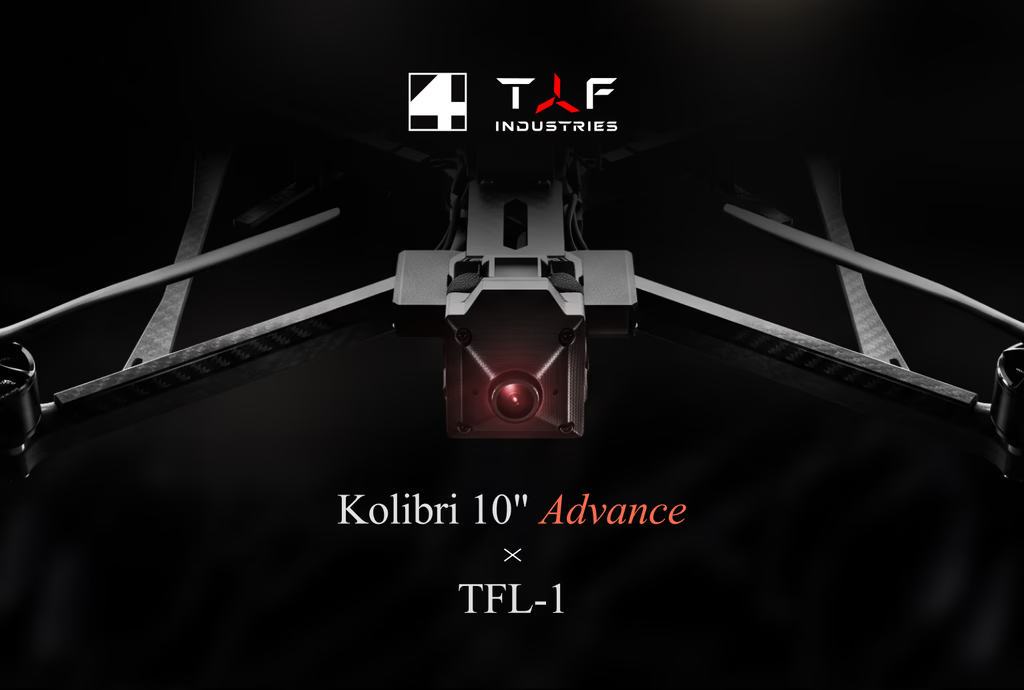

Source: The Fourth Law Target Acquisition: Utilizing the onboard TFL-1 AI module, operators can lock onto targets moving at speeds up to 80 km/h from up to 1,000 meters away.
Terminal Autonomy: Once locked, the drone enters fully autonomous terminal guidance, ignoring full EW jamming or loss of signal.
Cruise Mode: The system autonomously maintains heading, altitude, and speed through intense EW sectors without operator intervention.
Operational Range: Backed by dual-band communication and high-capacity battery power, the platform reaches beyond 40 kilometers.
According to developer data, integrating the TFL-1 module boosts mission success rates by 2–4 times. Earlier tests also confirmed the system’s adaptability: a specialized interceptor variant equipped with the TFL-AntiShahed module successfully tracked and destroyed a Russian Shahed/Geran-2 strike drone at a 1 km engagement distance.
Standardizing AI for Night Operations: NATO Codification of “Lupynis-10”
Autonomy is no longer an experimental luxury – it is becoming a standardized procurement metric. As reported by Militarnyi, the Lupynis-10-TFL-1-T night-strike FPV drone has officially received NATO codification.
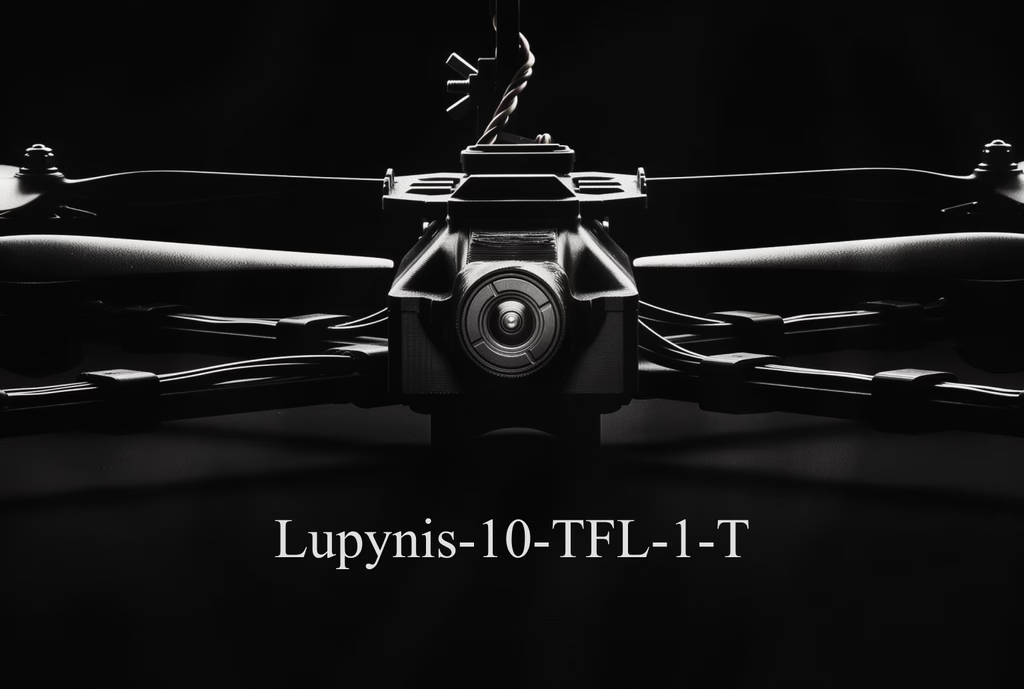
Built primarily with domestic components, the platform integrates several critical technological layers:
Thermal Vision: Features the Ukrainian-made Kurbas-640α thermal camera by Odd Systems for night identification.
Domestic Avionics: Powered by the Ukrainian Karma flight control stack housed inside a locally manufactured 10-inch carbon frame.
Terminal Accuracy: The TFL-1 AI algorithm targets the geometric center of an object, delivering a hit rate exceeding 70% under full EW disruption.
“AI-driven autonomy from The Fourth Law improves FPV mission success rates by 2-4 times while increasing overall unit cost by merely 10%”, company representatives noted.
The system is now available to Ukrainian defense forces via the DOT-Chain Defence procurement portal and the Brave1 Marketplace.
Heavy Lift Air-to-Ground Integration: Vampire and the ARK-1 UGV
Extending the operational radius of Unmanned Ground Vehicles (UGVs) traditionally presents a challenge: ground terrain limits line-of-sight communications and speeds up battery drain before reaching the contact line. Ukrainian forces solved this by coupling heavy airborne bombers with ground-based attack platforms.
As reported by Militarnyi, footage released by opposing forces confirms that Ukrainian units are using heavy multirotor drones – such as the Vampire class – to air-drop kamikaze UGVs directly behind enemy lines.
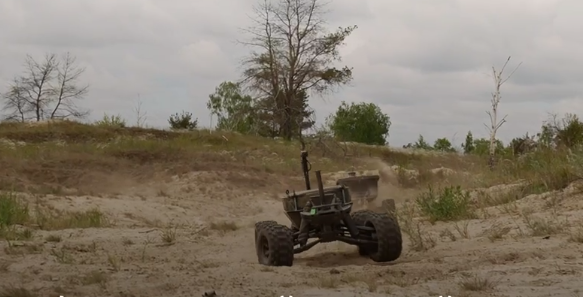
- Air Delivery: Heavy hexacopters transport compact UGVs over terrain obstacles via cable release systems.
Payload: The air-dropped ARK-1 – a compact, four-wheel-drive platform capable of speeds up to 45 km/h – was deployed armed with TM-series anti-tank mines.
Strategic Effect: Air transport preserves the UGV’s battery life for the final tactical approach, keeps heavy bomber drones outside the direct range of enemy small-arms fire, and achieves total tactical surprise.
Next-Level Amphibious Autonomy: The Kinburn Spit Operation
The most complex leap in robotic integration is cross-domain operation, where autonomous systems transport and deploy other autonomous systems across domain boundaries (e.g., naval to land).
As reported by Dev.ua, operators from the 123rd Separate Territorial Defense Brigade, utilizing hardware developed by DevDroid, conducted a first-of-its-kind amphibious assault on the occupied Kinburn Spit.
The Vector: An Unmanned Surface Vessel (USV) crossed open water carrying a track-mounted ground robot.
The Payload: The ground platform was equipped with DevDroid’s remotely operated Wolly 7.62 combat module.
Execution: Upon reaching the shore, the USV deployed the UGV to engage enemy positions autonomously on land, without requiring troops to set foot on the beachhead.
“The mission on the Kinburn Spit demonstrated the immense potential of multi-domain robotic operations, where naval and ground platforms execute tasks within a unified command loop”, stated DevDroid CEO Yuriy Poritskyi. “This shifts the core logic of combat operations: machines deliver other machines into hostile territory, completing tasks without direct human risk”.
The Strategic Shift
The rapid transition from manually steered FPVs to edge-AI target locking, heavy-lift air-dropped UGVs, and amphibious multi-domain robotic landings signals a permanent departure from traditional military attrition doctrines.
By replacing biological presence with interconnected autonomous machines, Ukraine is establishing a tech-first defense model designed to systematically defeat mass-infantry doctrines through technological superiority.