When synchronized waves of Shahed loitering munitions saturate a localized air defense sector, the primary vulnerability shifts from hardware inventory to human cognitive bandwidth. While kinetic drone interceptors have stabilized as a core asymmetric countermeasure, traditional manual piloting creates a severe operational bottleneck. Defending against multi-target swarms under heavy electronic warfare (EW) jamming has historically required an unattainable volume of elite FPV pilots operating in flawless weather conditions.
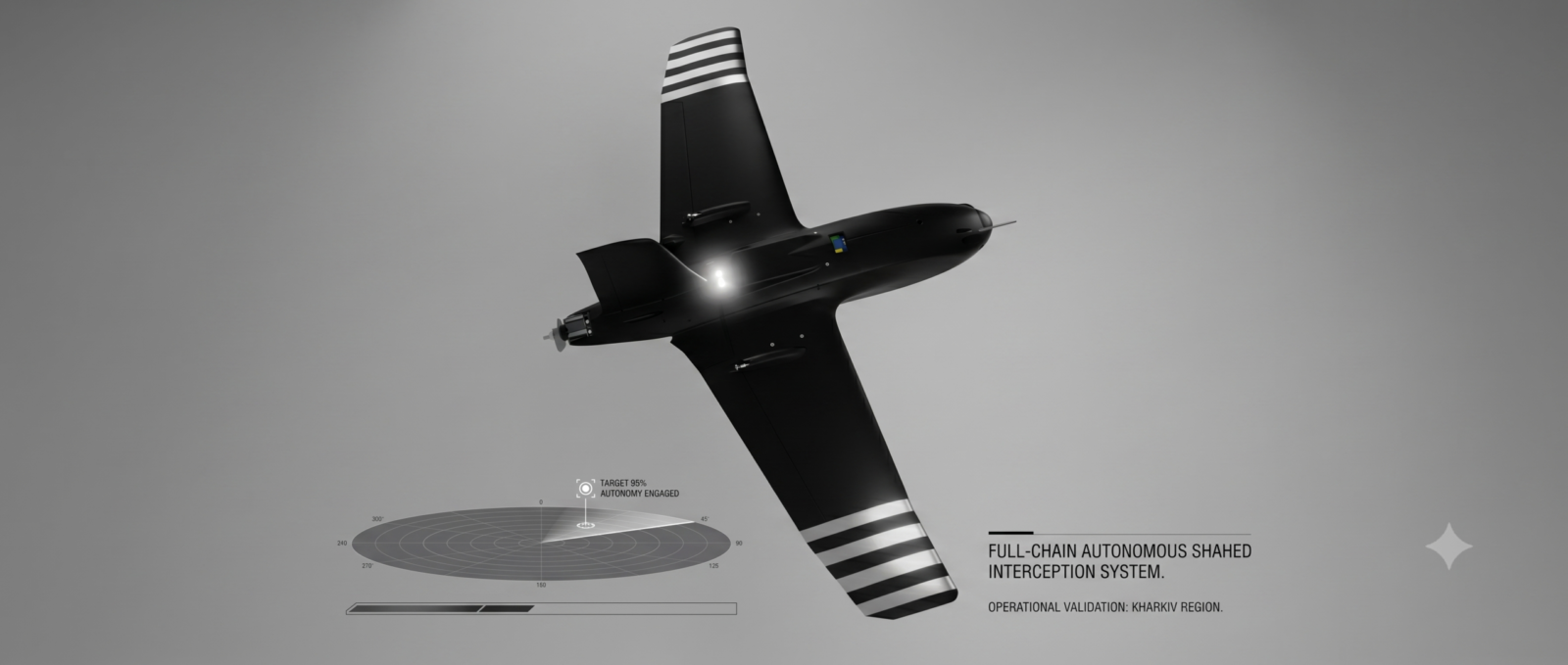
By automating 95% of the entire interception mission profile, Ukrainian defense tech startup MaXon Systems has engineered a structural shift: moving drone defense from human piloting to algorithmic scaling.
Combat-Proven Autonomy: De-skilling the Intercept
The ground-launched, fixed-wing platform has already achieved validated combat intercepts in the Kharkiv region, deployed by the 12th Separate Special Purpose Center. The operational milestones were publicly corroborated via flight footage released by Ukraine’s state defense tech cluster, Brave1.
The strategic urgency of MaXon’s full-chain automation is highlighted by frontline experience. Commenting on the logistical strain of intercept operations, the chief sergeant of an anti-drone UAV platoon from the 413th SBS Regiment “Raid”, callsign “Pegasus”, noted:
“If you break down the entire mission into phases, navigating to the target area and locating the threat consumes significantly more time than the actual terminal phase before auto-tracking can even engage”.
Speaking with Defender Media, MaXon Systems co-founder and CEO Oleksii Solntsev emphasized that their engineering focus was explicitly designed to solve this exact operational friction by removing human dependency from the flight path.
The system’s 95% autonomy rate effectively redefines the operator’s role from an active pilot to a high-level mission dispatcher across three distinct phases:
Automated Launch: The interceptor executes an automated takeoff and ascends to a pre-designated patrol altitude at the press of a single button.
Algorithmic Vectoring: Utilizing data from local radar networks and partner-provided ground beacons, the drone navigates to the target sector via autopilot. By fusing internal sensors with beacon telemetry, the platform maintains precise positioning completely independent of GPS signals, neutralizing Russian EW jamming.
AI Terminal Engagement: For the final “last mile” identified by Pegasus, the platform deploys advanced computer vision software – developed in partnership with a Dutch AI firm – to handle autonomous target detection, tracking, and proximity detonation within the target’s destruction zone.
The remaining 5% of human intervention is reduced to a point-and-click command: the operator simply selects the radar-identified target on a control station monitor and initiates the engagement.
“On the current iteration, we can cruise for up to 70 minutes during combat air patrols. We can comfortably maintain pursuit speeds of 200–250 km/h, and accelerate up to 300 km/h for several minutes if required”, Solntsev stated, noting a functional operational radius of 30 km per sector.
Institutional Backing and Cost Asymmetry
To finance the deep-tech R&D required to stabilize this full-chain autonomous software architecture, MaXon Systems secured a pre-seed investment round backed by a specialized syndicate of defense venture funds.
Expanding on initial momentum from the Defence Builder Fund and Freedom Fund, the startup attracted international venture capital from:
Green Flag Ventures (United States)
Hede Capital (Sweden)
Big Defence (Finland)
While the final valuation and total volume of the pre-seed round remain proprietary, the company previously disclosed an initial $300,000 tranche. At an estimated unit cost of $3,500 per interceptor, the platform establishes a highly scalable economic model for localized defense infrastructure.
From Early Scaling to the Next Paradigm
MaXon Systems has transitioned to the early scaling phase, actively progressing through state codification to unlock official domestic procurement contracts while delivering its first production orders to active frontline units.
The team is now structuring a $1M+ Seed round to scale assembly facilities and accelerate its next-stage R&D roadmap: multi-target remote control.
Much like Western distributed air defense architectures, MaXon aims to completely decouple the human crew from physical launch hardware. The upcoming framework will enable a single distributed command center – located hundreds of kilometers away from the frontline – to manage multiple automated launching stations simultaneously. This software-driven approach allows a minimal crew to dynamically distribute targets across an entire region, preparing air defense networks to counter increasingly dense saturation tactics and emerging jet-powered loitering variants.