In the global technology ecosystem, early-stage youth programs often struggle to bridge the gap between theoretical STEM education and market-ready engineering. While Western accelerators frequently fund software concepts and early-stage mockups, a parallel shift is occurring within Ukraine’s tech infrastructure. A generation that has matured entirely alongside complex security and logistical challenges is developing a pragmatic, hardware-first approach to innovation – yet much of this pipeline remains overlooked by international capital.
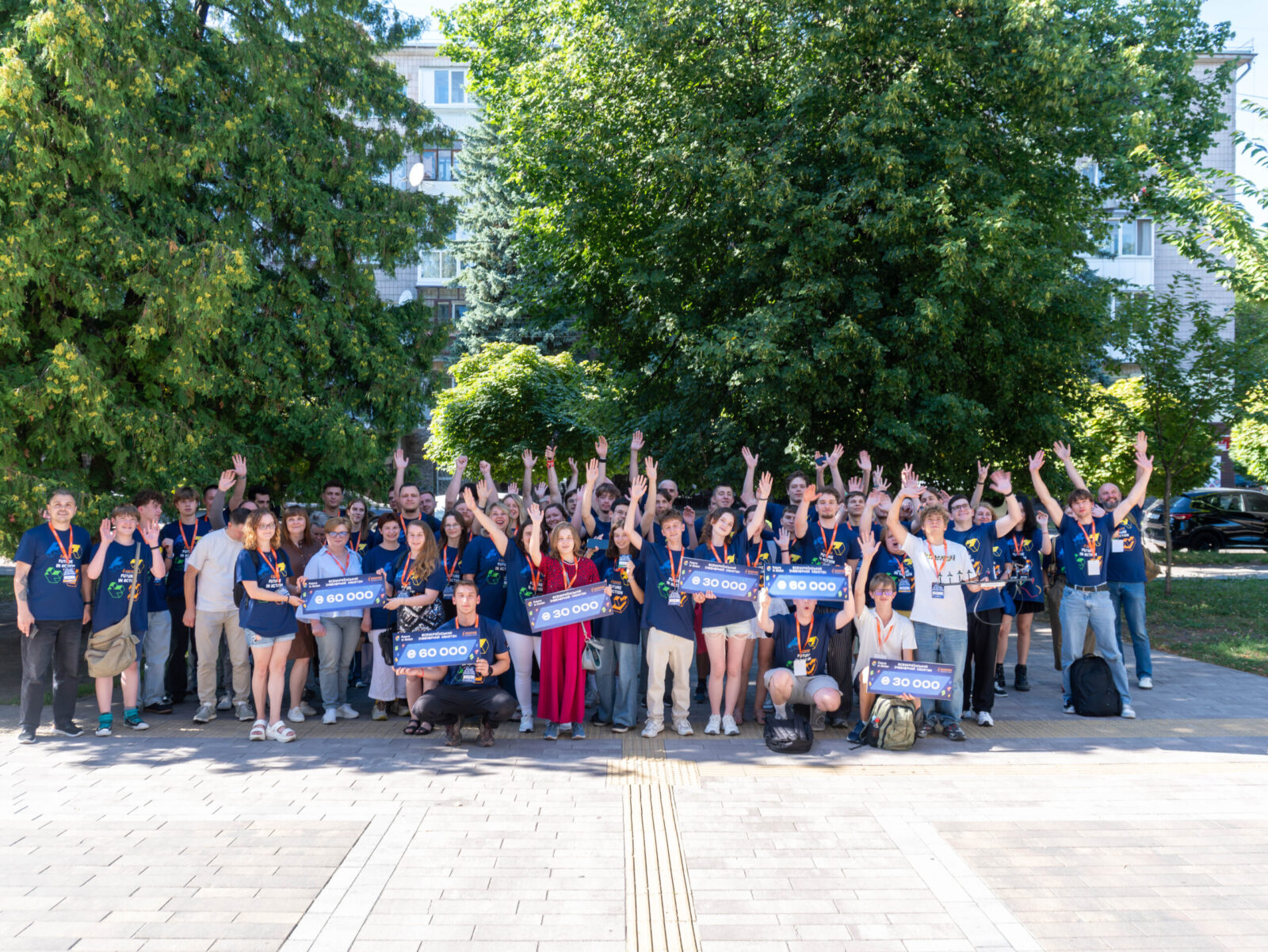
The recent Future in Action Hackathon in Zhytomyr demonstrated the speed and execution density of this demographic. Organized by the Noosphere Engineering School as part of its Orbital City Lab mission, the event brought together 312 participants, ranging from middle schoolers to university students and developers up to 25 years old.
Working across 90 regional teams, these young innovators built 69 working minimum viable products (MVPs) in just 48 hours.
Hardware Over Slides: Execution on Micro-Budgets
The structure of the event mandated deployable hardware and software solutions over polished pitch decks. Participants worked directly with technical mentors to assemble physical prototypes, program IoT sensor networks, and build AI workflows tailored for municipal use cases.
“Future in Action became a true engineering hackathon. The main focus was not on beautiful presentations, but on working solutions”, noted Serhiy Veretiuk, Head of Social Projects at the Noosphere Ecosystem. “For two days, teams constantly tested, refined their prototypes, and worked with mentors. Most importantly, this story does not end after the finals—we are ready to support them further”.
To assist with initial hardware components, local organizers distributed a grant fund of ₴270,000 (~$6,500) across two age divisions:
Junior League (Under 18)
Urban Mind (Dnipropetrovsk Region): Engineered a motion-activated adaptive streetlighting system with automated brightness scaling and traffic analytics. Awarded ₴30,000.
RadioEmergency (Kharkiv Region): Built an automated traffic-signal override mechanism designed to guarantee priority passage for emergency vehicles at intersections. Awarded ₴30,000.
FStep (Vinnytsia Region): Developed a smart parking module incorporating real-time occupancy detection and visual LED guides for drivers. Awarded ₴30,000.
Pro League (Ages 18–25)
Chillin (Lviv Region): Created an inclusive urban navigation tool mapping physical obstacles and generating accessible routes for mobility-impaired residents. Awarded ₴60,000.
Twix (Zhytomyr Region): Launched an AI management interface for volunteer operations, automating resource allocation and task verification. Awarded ₴60,000.
Kanifol (Zhytomyr Region): Designed a localized pedestrian lighting system that dynamically transfers signals between streetlamps to maintain a moving illumination zone around pedestrians. Awarded ₴60,000.
The Strategic Opportunity for International Ecosystems
While micro-grants allow teams to assemble immediate prototypes, the long-term trajectory of these developers relies on structural scaling. The winning teams, alongside other promising non-winning finalists, received invitations to continue their R&D inside the Noosphere Engineering School network, which operates 14 laboratories across eight Ukrainian universities.
However, domestic lab access represents only the foundation of this talent pipeline. As global municipal markets search for resilient, capital-efficient infrastructure technologies, connecting these early-stage R&D hubs with international universities, corporate pilot programs, and cross-border innovation funds creates a clear strategic advantage.
The execution capacity is already established at the grassroots level – the remaining question is how quickly international ecosystem partners will move to integrate it.