The historical paradigm of European defense procurement is shifting under the weight of unprecedented security threats from the East. For years, Europe relied on lengthy, multi-decade development cycles for its military hardware. However, the rapidly evolving nature of modern warfare has exposed a critical vulnerability: the continent lacks the agility to counter mass-scale, low-cost drone and missile doctrine. To bridge this strategic gap, Europe’s largest economy is turning directly to Ukraine’s battle-hardened defense technology ecosystem.
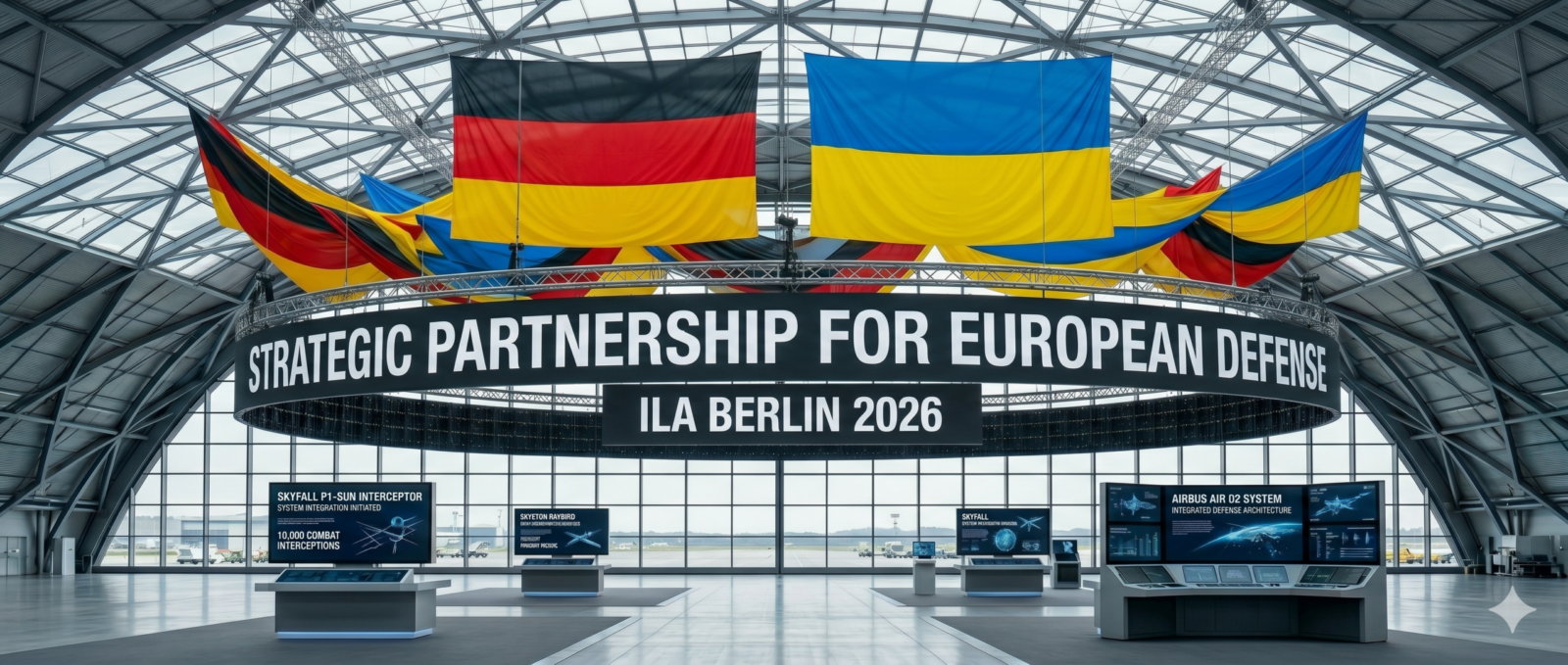
At the ILA Berlin Air Show on June 12, 2026, two landmark agreements underscored this integration. Ukrainian defense-tech innovators SkyFall and Skyeton signed strategic partnerships with European aerospace giant Airbus Defence and Space and German systems integrator INTEC. These deals mark a pivotal milestone, transitioning Ukrainian technology from local battlefield survival to the foundational architecture of continental European defense and the European Sky Shield Initiative (ESSI).
Airbus Integrates SkyFall’s P1-SUN to Secure European Skies
In the presence of German Defense Minister Boris Pistorius, SkyFall and Airbus Defence and Space signed a Memorandum of Understanding (MoU) to establish a strategic partnership. As first reported by Militarnyi, the primary objective is immediate and high-stakes: reinforcing the airspace defense of both Ukraine and European nations against massed drone and missile strikes.
The core of this partnership centers on deep systems integration. SkyFall’s P1-SUN interceptors will be integrated into the Airbus Air C2 (Airspace Management Command and Control) system.
The integration leverages massive empirical data:
Combat Record: The P1-SUN interceptor platform has already destroyed approximately 10,000 Russian drones of various types in active combat zones.
Strategic Payoff: This combat data provides Airbus with a plug-and-play solution capable of countering modern saturation attacks, shifting European defense from theoretical modeling to proven mitigation.
“The P1-SUN interceptors have already destroyed about 10,000 Russian drones of various types, confirming the technology’s effectiveness in countering aerial threats. This became the basis for our partnership with Airbus, within which we are working on creating a new-generation, multi-layered air defense system”, a SkyFall representative stated.
Michael Schöllhorn, CEO of Airbus Defence and Space, emphasized that countering modern aerial assault weapons requires extreme flexibility and short development cycles:
“Airbus brings system expertise and experience in the C2 field, particularly in Integrated Air and Missile Defense (IAMD), while the Ukrainian side brings invaluable combat experience and technologies proven in real-world conditions. Together, this will become another brick in creating a resilient, multi-layered air defense system that will be built with the speed required on the modern battlefield”.
INTEC Adapts Skyeton’s Raybird for the Bundeswehr
Simultaneously, Skyeton Germany GmbH – the European subsidiary of Ukraine’s Skyeton – signed a Letter of Intent with German defense contractor INTEC to adapt and supply tactical unmanned aerial systems directly to the German Armed Forces (Bundeswehr), according to details published by Militarnyi.
The partnership merges INTEC’s lifecycle engineering, AI-driven systems integration, and integrated logistics support with Skyeton’s highly successful Raybird platform. The Raybird is a small tactical unmanned aerial complex engineered for long-range, high-endurance reconnaissance missions under heavy electronic warfare (EW) suppression.
Key Technical Metrics of the Raybird Platform:
Operational Maturity: Over 350,000 hours of active combat deployment in Ukraine.
Extended Range: Recently integrated with satellite communication capabilities, extending its reconnaissance depth to a maximum flight range of over 2,500 km.
Power Plant: The platform features an electric motor running on hydrogen fuel cells.
Christoph Otten, CEO of INTEC, highlighted that this partnership grants Germany direct access to technologies forged in high-intensity warfare:
“The partnership with Skyeton provides access to technologies proven in real combat conditions. Such solutions are offered to the German market as a response to current and future challenges in the field of security and defense”.
A spokesperson for Skyeton Germany added:
“We highly value INTEC’s expertise and their deep understanding of the German defense environment. We are confident that this cooperation will help properly present the proven capabilities of Raybird on the German market”.
A New Era of European Technological Sovereignty
These agreements signify a deeper macroeconomic trend: Ukraine is cementing its role as Western Europe’s premier defense-tech powerhouse. By embedding combat-proven hardware directly into Germany’s defense infrastructure and Airbus’s broader command systems, these partnerships are not just commercial transactions—they are structural components of Europe’s technological sovereignty.
As the threat landscape from the East intensifies, the integration of Ukrainian deep tech suggests that the future of European deterrence will no longer be built in isolated Western laboratories, but co-authored on the digital and kinetic battlefields of Ukraine.