Interception of mass-deployed UAVs at speeds exceeding 300 km/h has emerged as one of the most volatile bottlenecks in modern tactical defense, largely because high-speed interceptor platforms consistently struggle with pitch instability and aerodynamic drift during high-velocity sprints. Addressing this specific flight-physics limitation while building an industrial foundation for mass output, Ukraine’s Ministry of Defense has officially codified and cleared the “Skazhenyi” (Furious) drone interceptor with terminal homing for operation in the Armed Forces of Ukraine, as reported by Militarnyi’s latest release.
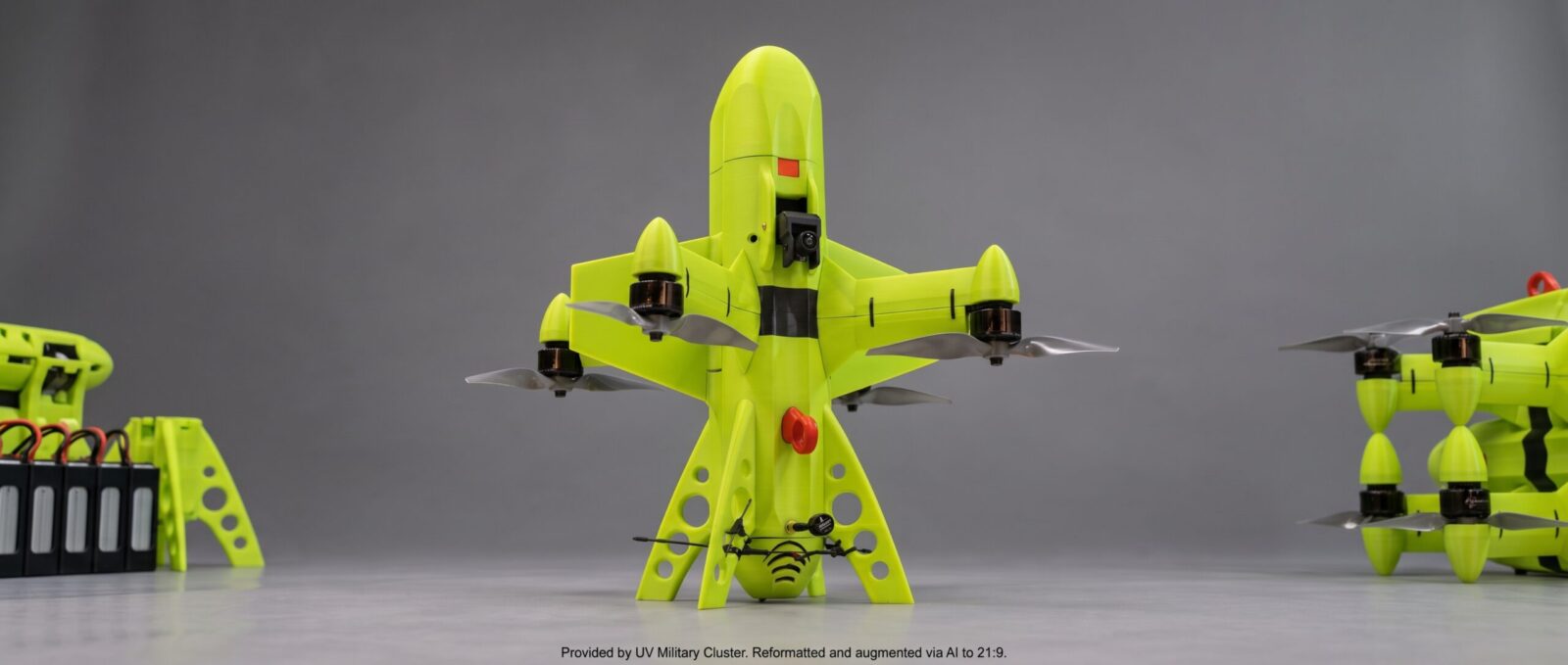
Developed by UV Military Cluster, the interceptor platform delivers automated terminal guidance alongside modular hardware, engineered to defeat Russian reconnaissance and strike unmanned aircraft along the contact line and across regional critical infrastructure.
The Cluster Advantage: Scaling Production from Day One
Unlike conventional early-stage startups that face lengthy scaling curves and hardware supplier bottlenecks, the development of Skazhenyi relies on a consolidated defense cluster model. UV Military Cluster functions as an alliance of unmanned systems manufacturers, bringing together 19 member companies and over 100 defense engineering specialists.
Official cluster data indicates an aggregate industrial capacity exceeding 160,000 UAVs per month, with an in-house manufacturing rate topping 20,000 systems monthly and a portfolio of more than 50 serial hardware models.
This unified manufacturing base enables rapid mass distribution: despite Skazhenyi being a new market entry, the consortium has already established a target production capacity of up to 5,000 units per month.
Aerodynamic Innovation: Centered Center of Mass
Most interceptors designed for steep acceleration suffer from a nose-up attitude during horizontal flight due to uneven payload distribution, degrading optical tracking and maneuver accuracy. The engineering team behind Skazhenyi mitigated this issue by designing the internal battery to pass entirely through the structural power frame, establishing an exact center of gravity.
“The platform flies in horizontal flight without a raised nose. This is a real problem in this class of products. As a result, it has proven exceptionally controllable”, the manufacturer told Militarnyi.
At the direct request of the Ukrainian Naval Forces, the platform was built around a modular architecture:
Detachable Lower Module: Allows field operators to swap communication and telemetry systems.
Detachable Front Section: Facilitates immediate exchange of video feeds between analog, digital, and thermal imaging optics.
Dual Airframe Architectures: Synthesizing combat experience from previous baseline interceptors such as Sting, P1-SUN, and Strila, the system is offered in both a winged version that clocks up to 310 km/h and a wingless variant capable of reaching 365 km/h (with a baseline standard operational speed of 340 km/h).
The drone utilizes vertical takeoff and landing (VTOL), requires 10 minutes for pre-launch setup and 8 minutes for pack-up, and remains operational in temperatures between −20 °C and +40 °C with wind resistance exceeding 7 m/s.
Tactical Specifications & Operational Envelope
The full product ecosystem features seven distinct operational variants, encompassing day and night missions, analog or digital video, and automated target-lock systems, as outlined in Militarnyi’s tactical launch coverage.
Maximum Speed: 340 km/h (up to 365 km/h in wingless configuration)
Maximum Operational Altitude: 7,000 m (rated operational ceiling up to 10,000 m)
Flight Time: Up to 15 minutes (with terminal guidance engaged) / up to 30 minutes (extended intercept profile)
Payload Capacity: 500 g warhead
Operational Range: 25 km tactical combat radius / 45 km maximum flight range
Control Link: Frequency-hopping spread spectrum (FHSS, 20–100 MHz within the 100–3020 MHz band / GEMINI)
Video Channel: Broadband transmission across 1.0–13 GHz
Deployment Realities and Foreign Market Trajectory
Initial operational units of the terminal-guidance Skazhenyi have already been delivered to front positions and regional air defense units in the Odesa and Zaporizhzhia regions. The rollout builds directly on nine months of tactical intercept missions conducted in close partnership with Odesa’s regional air defense teams.
However, operational deployment highlights evolving tactical dynamics. While highly capable against piston-engine loitering drones and tactical surveillance aircraft, the current iteration is not intended for jet-propelled loitering munitions.
“Unfortunately, it has not yet been possible to successfully deploy the platform with terminal guidance, because recently only jet-powered Shaheds have been flying into the Odesa region”, UV Military Cluster stated.
To improve battlefield versatility and operator safety, the manufacturer has also completed its first remote-piloting trials, enabling operators to guide intercepts from remote command nodes outside the direct hazard perimeter.
With Skazhenyi officially showcased on Ukraine’s defense innovation platform Brave1, the platform is beginning to transition toward foreign defense acquisition. UV Military Cluster reported that international partners have expressed active interest, and the consortium is currently finalizing its first export agreement. As frontline testing continues to refine the interceptor’s homing algorithms, the platform raises a pivotal question for Western procurement: can interconnected industrial clusters establish the new baseline for mass-produced, low-cost counter-UAS capabilities?