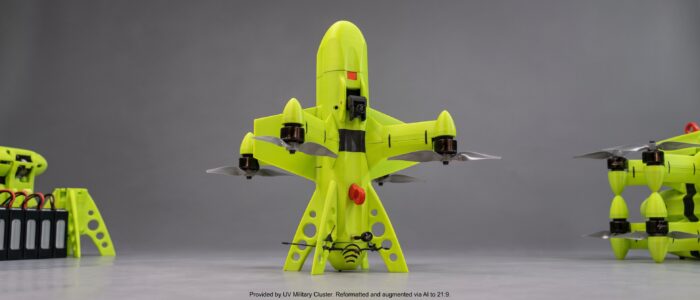
Ukraine’s unprecedented initiative to decentralize and privatize kinetic airspace protection is scaling at rapid speed. As of mid-September 2026, 81 domestic enterprises have formally joined the Ministry of Defense’s experimental program, securing official authorization to conduct targeted air defense operations across the country.

The operational milestone highlights a surging trajectory for what is becoming the world’s first structured “Air Defense as a Service” (ADaaS) market. A total of 92 enterprises spanning diverse ownership structures, strategic sectors, and geographic regions have submitted applications to deploy dedicated mobile and automated counter-UAS capabilities.
Scaling Up: From Pilot Phase to Kinetic Results
First launched at the end of 2025 by the Ministry of Defense of Ukraine, the experimental framework was designed to relieve state resources while shielding critical production facilities, logistics networks, and personnel from sustained drone and loitering munition assaults.
The pace of adoption has accelerated sharply over the past quarter:
Early June 2026: The network stood at 30 authorized commercial companies.
Mid-July 2026: The number reached 51 authorized enterprises out of 62 applicants. At that stage, dedicated mobile teams from the first four actively engaged enterprises had already neutralized more than 50 aerial targets, intercepting Shahed-type one-way attack drones and Zala tactical reconnaissance UAVs.
Mid-September 2026: Authorization expanded to 81 enterprises, representing a 58% increase in active corporate participants in two months.
Crucially, private air defense units do not act autonomously in sovereign airspace. Every deployment functions as a coordinated layer of Ukraine’s integrated air defense architecture, operating under the command, control, and situational synchronization of the Air Command of the Air Force of the Armed Forces of Ukraine.
Tracking the Market Shift: What We Have Observed Since April
At TechUkraine, we have been tracking the mechanics and technological architecture of this emerging sector since early April 2026, when the first commercial deployments began demonstrating outsized kinetic efficiency.
In April, Ministry of Defense reports confirmed that a private unit had successfully brought down a jet-powered Shahed drone flying at speeds exceeding 400 km/h, proving that civilian-staffed, tech-augmented squads could manage high-velocity target acquisition.
As our in-depth reporting revealed, the underlying engine driving this shift is software and hardware integration, pioneered by domestic deep-tech and defence-tech firms:
Automated Kinetic Interception: Companies like Carmin Sky deployed remote-controlled automated turrets guided by machine vision algorithms, enabling civilian operators using standard gaming interfaces to achieve an 85% efficiency rate with human-in-the-loop fire authorization.
Rapid Workforce Transformation: Specialized security operators such as Gvardiya created specialized training curricula turning civilians into qualified interceptor drone pilots within two to four weeks.
Electronic Warfare Integration: Signal-jamming integrators like Kvertus fused dynamic EW denial bubbles with kinetic interceptor groups to mitigate saturation strikes.
To maintain operational discipline, participant companies must satisfy strict verification criteria – holding valid security licensing, confirming critical infrastructure or defense contractor status, and clearing thorough sanctions screenings – before integrating into state situational awareness platforms such as SkyMap.
Strategic Outlook
With Ukraine’s defense doctrine targeting near-total aerial target detection and interception across more than 6,000 distributed infrastructure nodes, the state’s decision to open kinetic operations to accredited corporate actors is proving out as an efficient operational sandbox.
By combining startup agility, machine vision automation, and unified military command oversight, Ukraine is transforming defense from a state monopoly into a decentralized, tech-driven protection ecosystem.