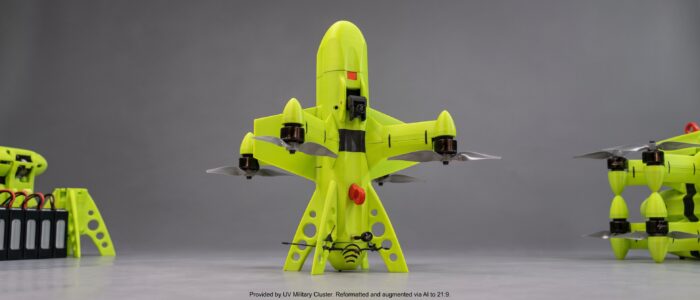
The electronic and kinetic battle for airspace control is entering a new phase. While the Ukrainian defence ecosystem has successfully industrialized the production of tactical interceptor drones reaching roughly 300 km/h, incoming aerial threats continue to evolve with the deployment of jet-powered loitering munitions. This tactical reality has created a clear engineering bottleneck: standard airframes can no longer bridge the velocity gap required for reliable point-defence interceptions.

Ukrainian defence manufacturer TAF Industries is shifting its engineering roadmap to address this high-velocity requirement directly, while executing a broader multi-domain expansion spanning naval assets and strategic strike capabilities, according to an interview with CEO Volodymyr Zinovskyi published by dev.ua.
Closing the Velocity Gap: 450+ km/h Interceptors
Rather than iterating on lower-speed designs already saturated by domestic manufacturing capacity, TAF Industries bypassed conventional interceptor brackets to build a ground-up platform engineered specifically to neutralize jet-powered Shahed variants.
“We decided that the market already has enough interceptors that reach speeds of around 300 km/h – that operational demand is covered. Therefore, we abandoned the idea of making another standard interceptor and are working on a solution that will achieve speeds in excess of 450 km/h”, explained Volodymyr Zinovskyi, CEO of TAF Industries.
The platform is an entirely proprietary development and has already completed successful flight trials. Serial mass production is scheduled to launch before the end of the year.
Multi-Domain Expansion: Equity Stake in Naval Tech
Beyond aerial platforms, TAF Industries is extending operations into the maritime domain via a strategic equity partnership with an undisclosed domestic naval drone developer.
“We haven’t tapped the maritime domain yet”, Zinovskyi noted. “We have a potential partner with whom we are already cooperating during ongoing military field trials. In the near future, I believe we will formalize this partnership and officially announce that naval systems are entering our product portfolio alongside our aerial drones and robotic ground complexes (UGVs)”.
This targeted acquisition model enables TAF Industries to scale its product catalog horizontally without spending years replicating specialized hull hydrodynamic engineering internally.
Long-Range Strike Pipeline and Advanced ISR
Over the next six months, the manufacturer also plans to roll out proprietary middle-strike and deep-strike unmanned platforms to serve long-range operational requirements.
In parallel, TAF Industries is diversifying its aerial reconnaissance footprint. While maintaining ongoing iterative upgrades to its widely deployed, cost-effective “Babka” recon drone, the company is building an advanced, higher-tier reconnaissance UAV.
“On one hand, we continue improving ‘Babka’, but we are also working on a new platform. It represents a completely different class in terms of technical specifications, but naturally comes at a significantly higher cost point than ‘Babka’. By launching this new reconnaissance system, we will give operators greater flexibility to choose the most effective tool for specific mission profiles”, Zinovskyi confirmed.
Ecosystem Context: The Evolution of an Integrated Defence Architecture
This multi-domain pivot marks a decisive evolution in TAF Industries’ broader industrial strategy. As TechUkraine tracked over the past year, the company has methodically assembled a vertically integrated battlefield ecosystem. In late 2025, TAF Industries disrupted electronic spectrum warfare with its next-generation battlefield EW ecosystem, transitioning from reactive jamming to proactive electromagnetic dominance with its modular “Kvazar” suppression complexes and real-time spectrum analytics.
That breakthrough directly complemented the manufacturer’s earlier operational milestones, when TAF Industries debuted a trio of tactical systems engineered to redefine frontline cost asymmetry – including the hibernating “Power Key” ambush architecture, the “KOLIBRI 13 FR1” optical signal repeater, and the ultra-low-cost “Babka” reconnaissance UAV. By bridging localized EW dominance, distributed unmanned swarms, and now high-speed interceptors and naval strike assets, TAF Industries is cementing its footprint as a comprehensive, end-to-end hardware platform in modern asymmetric warfare.