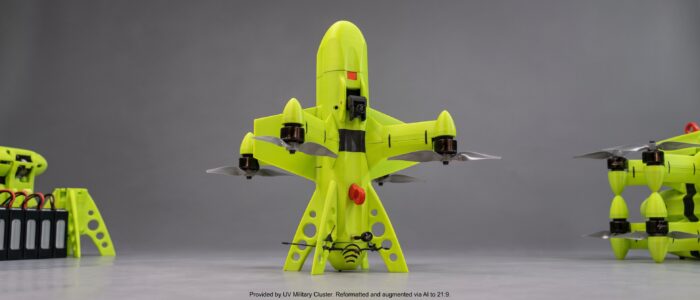
A new Ukrainian reconnaissance drone complex, the Buntar-3, is poised to join the ranks of the country’s defense forces, promising a significant boost in situational awareness thanks to its deep integration of artificial intelligence algorithms.

Developed by Buntar Aerospace, the unmanned aerial system has successfully completed testing and has been codified by the Ministry of Defense of Ukraine, signaling its readiness for widespread operational use. The “3” in its name denotes the third iteration of development, with combat testing confirming its reliability and effectiveness in real-world scenarios.
“We are at the stage where we can confidently say: Buntar-3 is ready for large-scale combat deployment”, stated a representative from Buntar Aerospace. “The first complexes are already operational on the battlefield, and they are not just ‘flying around’ – they are tackling real tasks, helping to neutralize targets, and gathering crucial intelligence”.
The Buntar-3 is an electric vertical take-off and landing (VTOL) drone boasting an impressive flight endurance of up to 3.5 hours, a record for electric VTOLs. Critically, it features navigation independent of satellite systems, enhancing its resilience in contested environments.
Designed for identifying key targets and providing fire correction at the operational-tactical level, significant attention has been paid to the reliability of its communication systems. The Buntar-3 offers a dependable operational range of 80 km, further extended by an integrated camera that allows for engagement of targets at distances of up to 15 km, keeping it outside the enemy’s immediate strike zone.
The developers highlighted the drone’s robust performance in the face of electronic warfare, a common challenge in modern conflicts. “Unfortunately, we often see significant interference from enemy (and sometimes even our own) electronic warfare, which disrupts missions. The combination of our radio communication modems, their power, frequency range, software, and antennas allows us to operate excellently under EW conditions”, they explained.
A key strength of the Buntar-3 lies in its custom-built software suite featuring deep integration of AI elements. This “Copilot” system aims to minimize operator errors, a primary cause of reconnaissance UAV losses, by automating numerous routine processes and providing crucial decision support.
“In a combat zone, an operator cannot afford to make a mistake. But they are human, they get tired, worried, and can lose concentration. We started from this premise and said: let the drone do everything for them that can be automated”, the developers elaborated. The Copilot system offers enhanced situational awareness, assists in critical decision-making, and flags potential risks, ultimately streamlining mission planning and execution.
This level of automation extends to mission planning, moving beyond simple waypoint navigation to comprehensive scenario-based planning that considers battery life, wind conditions, altitude, and communication reliability. The system can even predict return times and coordinate the launch of subsequent drones to ensure continuous observation of targets.
Furthermore, the Buntar-3’s automation capabilities enable a single operator to manage multiple drones simultaneously, providing a comprehensive aerial picture with real-time data on aircraft, routes, telemetry, and camera feeds. This reduces crew workload, accelerates drone rotation, and paves the way for uninterrupted 24/7 reconnaissance.
In a significant move towards enhanced security and reliability, the Buntar-3 eschews GPS navigation in favor of optical navigation and aircraft signal triangulation. The software complex also includes unexpected features like integration with the Signal messenger, allowing for seamless visualization of files received from allied units.
With testing and codification complete, the focus now shifts to mass production. While specific volumes remain undisclosed for security reasons, the developers confirmed strong demand from various units and the commencement of contracting. “We consciously did not launch mass production until we had a product that is truly needed on the battlefield. We went through three modifications. And now is the moment when we can go into series production”, the company stated. “We are preparing to launch mass production. We will not disclose the planned volumes for security reasons, but let’s just say: an entrepreneur will always find a way to scale up; it’s always a matter of resources and management”.
Source: MILITARNYI