In February 2024, international law firm CMS supported by Amazon Web Services, Perkins Coie LLP and TechUkraine held an online event dedicated to the analysis of the US and UK jurisdictions for tech startups entering new markets.
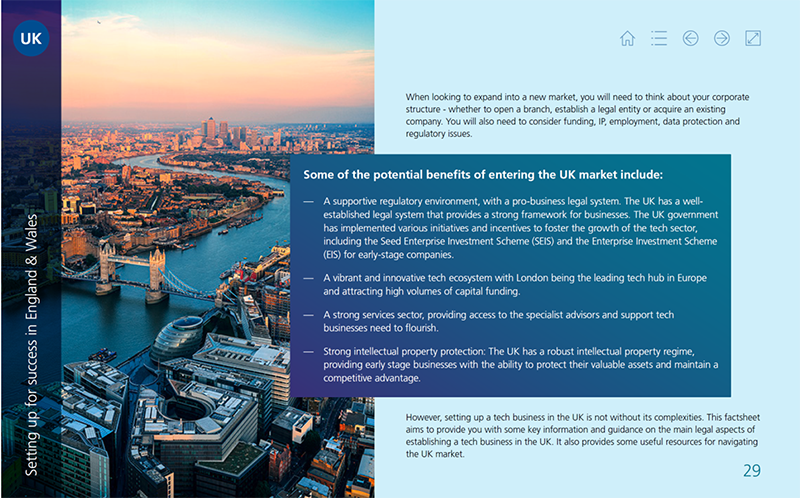
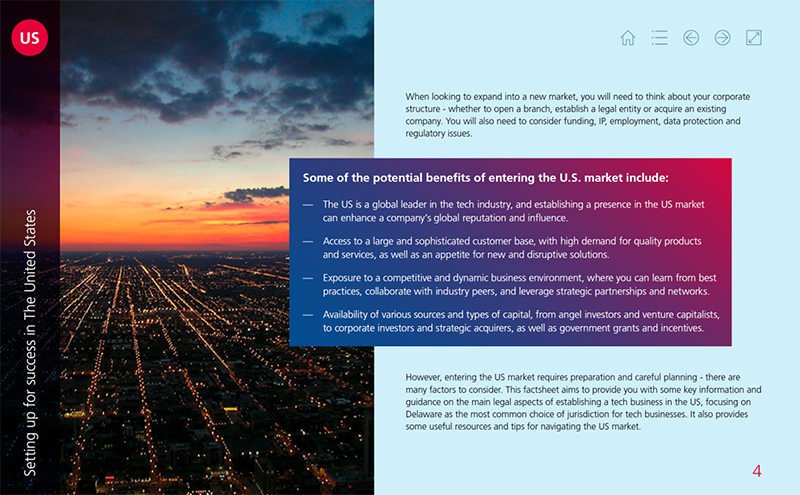
This online meeting was a summary of the huge work on an immense expert research work GOING GLOBAL: Factsheet for tech startups. It’s a 300+ pages guide that includes key considerations about new market evaluation, opening a branch, establishing a legal entity, and acquiring an existing company; tips on funding, intellectual property, tax, data protection, and regulatory issues.
Here we extracted some main hints from “The GOING GLOBAL Factsheet” for expanding startups.
How does a company open a branch abroad?
- Market Research: The company must conduct thorough market research to identify potential opportunities and challenges in the target market.
- Legal and Regulatory Compliance: Understanding the legal and regulatory requirements of the target country is crucial. This includes business registration, tax obligations, employment laws, etc.
- Establishing a Legal Entity: Depending on the country, the company may need to establish a legal entity such as a subsidiary, branch office, or joint venture.
- Hiring Local Talent: Hiring local talent who understands the market and culture can be beneficial for the success of the branch.
- Infrastructure Setup: Setting up the necessary infrastructure such as office space, technology, and logistics.
- Marketing and Branding: Tailoring marketing and branding strategies to suit the local market’s preferences and cultural nuances.
- Ongoing Operations: Managing day-to-day operations effectively while adapting to the local market dynamics.
Who owns the intellectual property rights in a startup?
In a startup, the ownership of intellectual property (IP) rights typically depends on agreements between co-founders, employees, and investors. Generally, the following principles apply:
- Founders: Founders usually own the IP they create before forming the company unless there are agreements stating otherwise.
- Employees: IP created by employees in the scope of their employment is often owned by the company, as per employment agreements.
- Investors: Investors may negotiate for certain IP rights as part of their investment terms, such as licensing rights or ownership stakes in the IP.
What issues could prevent investors from funding?
- Lack of Market Validation: Investors want to see evidence that there is a market need for the product or service.
- Weak Business Model: If the business model is not sustainable or scalable, investors may be hesitant to invest.
- Inexperienced Team: Investors look for experienced and capable teams to execute the business plan.
- Legal or Regulatory Risks: Legal or regulatory issues can be a significant deterrent for investors.
- Competition: If the market is overcrowded with competitors, investors may see limited potential for growth.
- Poor Financials: Lack of clear financial projections or unsustainable financials can deter investors.
How does legal illiteracy hinder sales?
- Misunderstanding Contracts: Legal illiteracy can lead to misunderstandings or misinterpretations of contracts, leading to disputes or lost opportunities.
- Non-compliance: Ignorance of legal requirements may result in unintentional non-compliance, leading to legal penalties or damage to reputation.
- Ineffective Negotiation: Without a solid understanding of legal terms and implications, sales negotiations may be less effective, leading to unfavorable deals.
- Liability Risks: Legal illiteracy may lead to inadequate risk management, increasing the company’s exposure to liability risks.
- Missed Opportunities: Legal illiteracy may result in missed opportunities to leverage legal frameworks or protections to enhance sales strategies or secure advantageous deals.
Those tips are relevant for any market startup wants to enter. But of course, each jurisdiction has its specifics.
The document “The GOING GLOBAL Factsheet” is a comprehensive study of two volumes, 300+ pages each, and covers 13 jurisdictions – the US, the UK, and a wide range of CEE countries including Poland, Czechia, Bulgaria, Hungary, Romania, and others.
To receive the document please fill in the form to request the full version: https://forms.gle/fbfiKSD71A9fBafJ8