Ukraine is currently the most mined country in the world. According to the Ministry of Economy of Ukraine, as of the end of 2024, the area of potentially contaminated land is 138,500 square kilometers. Traditional methods of demining would take almost a century to clear this land of explosive hazards. However, innovative remote detection technologies, combined with the power of AI, are significantly accelerating this process.
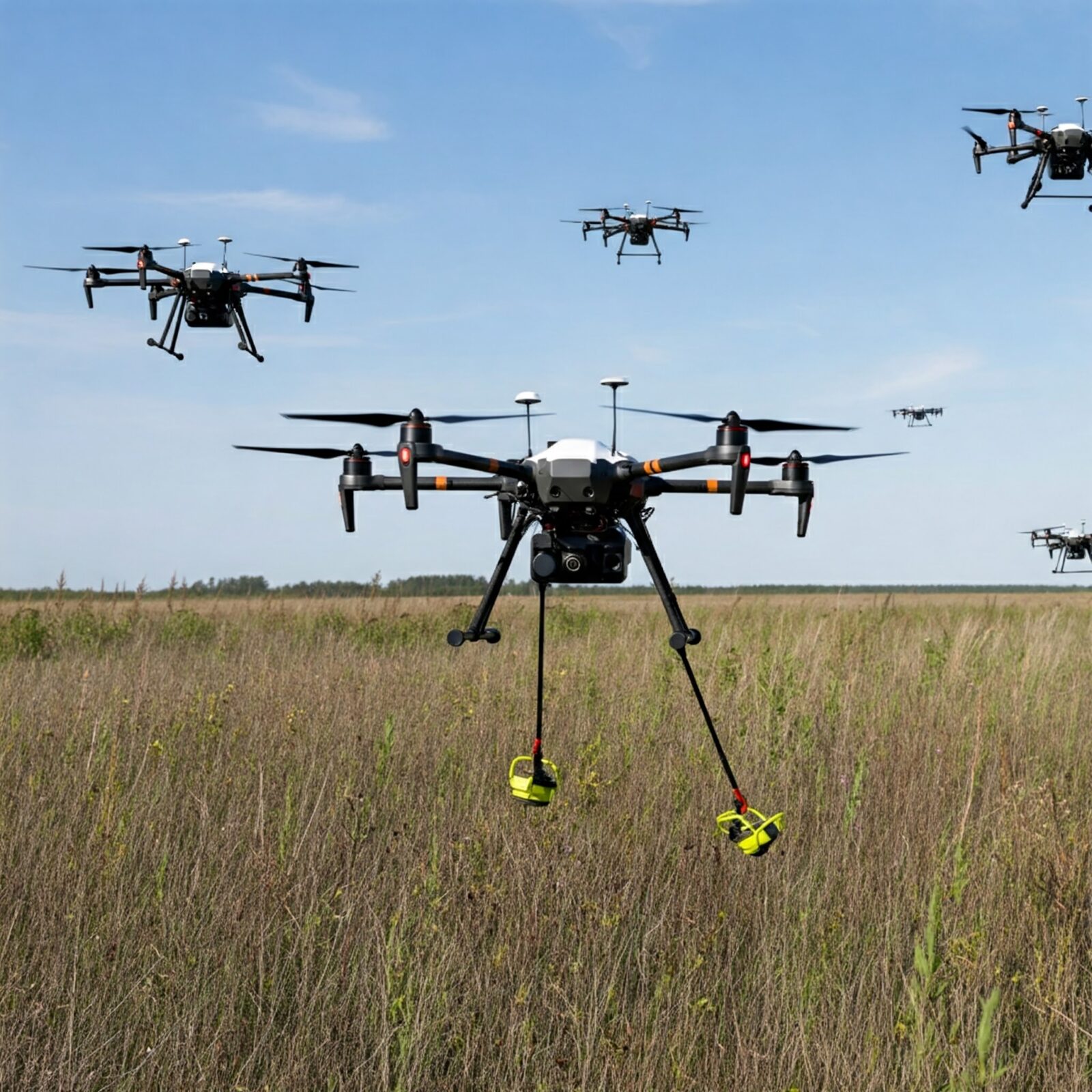
Sensor Technologies in Humanitarian Demining
In May 2024, the United Nations Development Programme (UNDP) conducted extensive testing of various sensor types for detecting explosive ordnance. High-resolution cameras, thermal sensors, and magnetometer-based technologies proved to be the most effective.
- Thermal sensors detect heat and can identify objects that are not visible to the naked eye. For example, a mine or other explosive object can heat up under the sun and emit heat that a thermal sensor can recognize.
- Magnetometers locate metal objects by measuring the magnetic field. The metal in mines or unexploded ordnance affects this field, and the magnetometer “senses” these changes.
Each type of sensor has its advantages and limitations. High-sensitivity optical cameras mounted on drones effectively detect objects on the surface. However, their use can be complicated by vegetation or other obstacles. Magnetometers can find mines and other unexploded ordnance containing metal, but their effectiveness is reduced by the presence of debris, including metal, in the soil. A particular challenge is the detection of plastic mines with minimal metal content.
“We are now coming to the realization that it is necessary to develop technologies that would combine different sensors. After all, there is no such universal tool that would work in any case with any type of explosive object,” explains Edward Crowther, a UNDP mine action specialist.
The Role of AI
Artificial intelligence (AI) is being used to analyze data collected by sensors, significantly speeding up the process. “So far, AI is mainly used for processing visual data,” explains Crowther. “For example, when a drone flies over a certain area that is suspected of being contaminated, it takes hundreds, maybe thousands of different images. Then they need to be checked for signs of certain explosive objects – anti-personnel mines, for example. And this leads to a significant increase in productivity in the processing of such images because a machine based on artificial intelligence can process these images much faster and more accurately than a human.”
Despite all the successes, Crowther emphasizes that there must always be a human present in the work of AI during data processing to verify the information. After all, humanitarian demining is primarily about the safety of people.
Ukraine: A Testing Ground for Innovation
Ukraine has become a testing ground for the development of innovative demining technologies. Thanks to the combination of international experience and local innovations, effective solutions are being created to overcome unprecedented challenges in the field of demining.
During the tests conducted in May 2024, some companies managed to detect 78% of hazardous items on the surface, about 70% underground, and 62% of plastic items.
Challenges and the Path Forward
A serious challenge for Ukraine in the development of sensor technologies for detecting hazardous items is their standardization and certification. After all, today there are no standards in the world for the use of sensor technologies to detect explosive objects.
The development of remote detection technologies for explosive objects will help Ukraine develop a clear system for prioritizing land for humanitarian demining. In this direction, the Society of Explorers of Ukraine is actively working. With the support of the Food and Agriculture Organization of the United Nations (FAO), they have created a map of craters and damage to the soil cover for the Kharkiv region and are now expanding their work to the Mykolaiv and Kherson regions.
Ukrainian Companies Making a Difference
Innovative solutions for humanitarian demining are being actively developed in Ukraine. Among the notable players in this market are the “Postup” Charitable Foundation and UADamage, which have created their own systems for remote detection of explosive objects.
Both companies are actively cooperating with the State Emergency Service of Ukraine and international partners, conducting tests in various regions of Ukraine. Their developments can make an important contribution to the global practice of humanitarian demining. In particular, active work is underway to fully automate the demining process.
Towards a Safe Future
The development of technologies for the remote detection of explosive objects is critically important for Ukraine. The combination of different types of sensors, drones, and AI makes it possible to significantly speed up the demining process and make it safer for deminers. Ukrainian companies are creating unique solutions that will not only help clear the territories of our country but also change approaches to humanitarian demining on a global scale. This gives hope that the restoration of a safe life in the liberated territories will become possible in a much shorter time.
Source: LIGA.net