More than 1,300 participants took part in an online marathon to create solutions for the preservation of the cultural heritage of Ukraine.
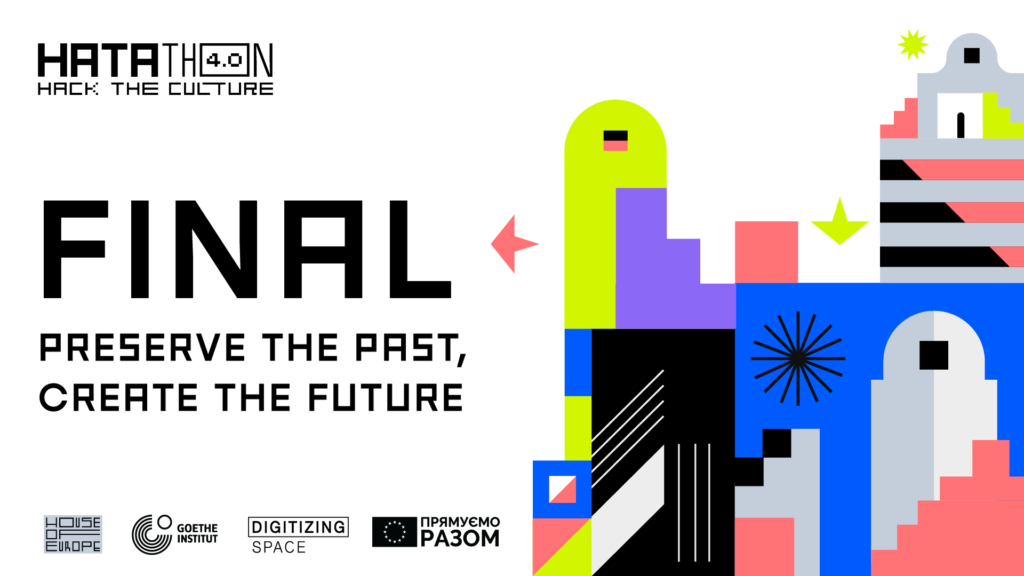
The Hatathon 4.0: Ukraine Heritage Edition, organised by the EU-funded House of Europe programme, Goethe-Institut in Ukraine, and innovation agency Digitizing Space, took center stage last week. This seven-day online marathon united technological prowess, creativity, and professional expertise to safeguard Ukraine’s rich cultural heritage, providing a beacon of hope amidst the challenges of the ongoing war. 1,300 participants from diverse backgrounds, including activists, creatives, and technology specialists, joined forces, bringing a wave of inspiration to digitise and revitalise cultural landmarks. As 15 teams showcased their projects on the final day, Hatathon 4.0 emerged as a powerful platform, uniting cultural, creative, and tech clusters.
Opening
The Hatathon’s official opening on 24 July witnessed influential speakers such as Francizka Simon, Head of House of Europe, Ilona Demchenko, International Сooperation and Infrastructure Grants at House of Europe, Anastasia Sleptsova and Anastasia Sylenok, co-founders of Digitizing Space, and other distinguished personalities. Among them were representatives from ALIPH Foundation, Sandra Bialystok, Director of Communications and Partnerships, who shared insights on their efforts to protect cultural heritage in conflict zones. Meanwhile, Sofie Taes from the Europeana Network Association Management Board and Tom Miles, Metadata Coordinator at Europeana Network Association, and Fulgencio Sanmartin, a policy officer at the Digital for Culture Unit of the European Commission, highlighted the Europeana project as a crucial platform for digitising European heritage, fostering cooperation opportunities with Ukraine.
Educational part
The Hatathon’s educational programme was equally vibrant, with Ukrainian and international experts conducting two days of lectures and workshops.
- Digitising Heritage — Iryna Glik, a certified specialist in digitising cultural heritage, unraveled the mysteries behind how cultural heritage objects are digitised and how to plan a successful digitisation project.
- Experience Design for Cultural Institutions — Alex Bulat, Founder & CEO at Bellaciao.dev, delved into the art of experience design, crafting innovative tools for cultural institutions to engage and captivate their audiences.
- Data Privacy & Storage — Andrii Udovychenko, Workflow Designer at Bot&Partners, offered insights into secure data storage solutions and the importance of data privacy, ensuring precious cultural assets remain protected.
- Web3 for Cultural Institutions — Taisiia Poda, a creative producer and art director in multimedia and tech-heavy art, and Denys Krupodorov, aka Jungle Symbol, a digital visionary artist and art collector, explored the possibilities of Web3 technology for cultural heritage preservation.
- Curation & Storytelling — Sofie Taes, Vice-Chair of the Europeana Network Association Management Board, and Aleksandra Strzelichowska, Senior Online Marketing Specialist at Europeana, conducted a captivating workshop on making cultural collections easy to discover, intertwining the power of storytelling to engage audiences.
- AI for Cultural Heritage — Oleksandr Krakovetsky, CEO at DevRain, Microsoft AI Most Valuable Professional, dove deep into the complexities of leveraging artificial intelligence to preserve cultural heritage.
- Immersive Technologies for Heritage — Svitlana Korshunova, Curator of the Artefact art project and Project Manager at Digital Culture, unveiled the enchanting world of VR, AR, and Meta Realities, showcasing how these technologies are used to promote cultural heritage.
- 3D Scanning for Preservation — Yurii Prepodobnyi, Co-Founder at SKEIRON, presented intriguing case studies, including the Mariupol Theater, illustrating how 3D scanning technology preserves cultural heritage in its most intricate details.
- The #TouchTheWarInUA Project — Stanislav Onopriienko, the initiator of #TouchTheWarInUA, cancelrussianow, and mask of maidan projects, highlighted the significance of 3D scanning technologies, enabling us to touch history and honor our heritage.
- No-Code Tools: Rapid Project Creation — Stepan Doktor, Founder & CEO at 5.0 Solutions, and Andrii Udovychenko, Workflow Designer at Bot&Partners, delved into the world of No-Code tools, unveiling the secrets to quick and efficient project creation online.
The Hatathon’s educational programme was a treasure trove of insights, equipping participants with the knowledge and skills to become cultural tech pioneers, forging a path towards a digitally enriched and preserved Ukrainian heritage.
Winners
The Hatathon’s crowning moment arrived with the evaluation of projects by the esteemed jury on 30 July. Expert panelists, including Ilona Demchenko, Irina Glik, Oleksandr Diatlov, Oleksandr Yatsenko, and Daryna Zhyvohliadova, carefully examined 90 projects. After final pitching and spirited deliberation, the jury selected three winning projects, leaving a lasting impact on preserving Ukraine’s cultural heritage:
- 1st place, EUR 2,500 — NGO Memories of Ukraine with the project “Memories of the military”. An initiative aims to create digital memorials for military personnel based on their wartime memories. These digital memorials in the form of physical plaques are installed in cities, schools, and universities where the military lived, studied, and worked. Thanks to augmented reality, short films are sewn into the plates, which transports the audience to the experiences and exploits of the heroes.
- 2nd place, EUR 1,500 — City of Mary with the project “RE: MARIUPOL”. An innovative project aimed at presenting the joint achievement of Ukrainian intellectuals, public activists, and initiatives seeking to popularise, rethink and preserve the historical and mental image of the city of Mariupol. The project’s goal is to create a multidimensional interactive base that will preserve the uniqueness of the cultural environment and help break the stereotypes of the perception of the city.
- 3rd place, EUR 1,000 — MS with the project “Meta Spadok”. It aims to preserve Ukrainian cultural heritage by creating digital reproductions of traditional Ukrainian clothing from various regions. Using modern technologies and its own creative approach, the project transfers the memory of past generations by sewing and modeling exhibits from scratch and transferring them to Web 3.0.
In addition, the NGO Memories of Ukraine team also won an additional nomination from the Europeana Network Association. Team members will participate in the three-day Europeana Tech 2023 conference, which brings together more than 1,000 international professionals working in the field of digital cultural heritage in Europe.
Two teams also received an additional prize — the opportunity to attend the iForum conference, which brings together investors, corporate leaders, developers, marketers, economists, stars of the IT world, creators to find ways of development and ideas:
- MIA team with “EtnoHut” project. It’s an educational and booking platform that offers an immersive experience of studying the Ukrainian ethnos and its integration into the traditional Ukrainian life of the last century. The team aims to develop a unique educational and booking platform that will allow you to study authentic ethnic estates and book them for visiting and staying.
- UBe team with “Ukrainian Beat” project. This cultural and charitable initiative promotes Ukrainian art and artists living abroad while raising funds for humanitarian and social needs. The project combines various types of arts and promotes cultural exchange between Ukrainians and foreigners, aiming for the Ukrainian “beat” to be heard worldwide.
As the judge of the Hatathon and Chairman of the Board at Techosystem Oleksandr Yatsenko noted, this project became a powerful proof of how the latest technologies can become an effective ally for the preservation of culture: “Together we are building a bridge between the past and the future, allowing digital innovations to reproduce and record valuable cultural treasures for future generations. The projects of Hatathon participants opened new milestones in the possibilities of protecting and popularizing our heritage, and they have great potential for positive changes in society.”
In the words of Anastasia Sleptsova, co-founder of Digitizing Space, “The Hatathon 4.0: Ukraine Heritage Edition has proven to be a powerful catalyst for merging technology and creativity. Together, we are empowering cultural heritage preservation, ensuring its digital existence for future generations.”
The Hatathon 4.0: Ukraine Heritage Edition stands as a testament to the incredible potential of the tech community, coming together with a shared vision to create lasting solutions for preserving Ukraine’s rich cultural heritage.
Press Inquiries
Yanina Shabanova
shabanova1992@gmail.com
Connect with the organisers
House of Europe https://houseofeurope.org.ua/en
The Goethe-Institut https://www.goethe.de/ins/de/en/kur.html
Digitizing Space https://www.digitizing.space/
About the organisers
House of Europe is an EU-funded programme fostering professional and creative exchange between Ukrainians and their colleagues in EU countries and the UK. The programme focuses on different professional fields: culture and creative industries, education and youth work, social entrepreneurship, and media. Implementation of the House of Europe programme is led by Goethe-Institut Ukraine.
The Goethe-Institut is the Federal Republic of Germany’s cultural institute, active worldwide. It promotes the study of German abroad and encourages international cultural exchange.
Digitizing Space is an innovative agency that designs digitally inclusive projects and programmes, helping businesses, communities, and civil society organisations transform and re-think online human collaboration to foster digital inclusion.