Kyiv, Ukraine – In a significant display of wartime innovation, Ukrainian defense-tech companies are rapidly evolving their unmanned aerial systems, pushing the boundaries of payload, range, and operational stealth. At a recent Demo Day hosted by the Brave1 defense technology cluster, two standout developers, the teams behind the Darts and Frontyr strike drones, revealed crucial upgrades aimed at giving Ukrainian forces a decisive edge on the battlefield.
The event, part of a series of trials by Brave1, is focused on identifying and scaling comprehensive FPV drone solutions capable of striking targets at distances of 40+ kilometers, a mission profile that critically relies on the use of aerial repeaters.
Darts: The Heavy-Hitter Gets a Twin-Engine Upgrade
The manufacturer of the Darts strike drone, already supplying small batches to the military, has unveiled a formidable new twin-engine model. This upgraded airframe represents a quantum leap in capability, boosting its payload capacity to an impressive 12-14 kilograms.

“Compared to the single-engine Darts, we have a much larger payload”, a company representative told Militarnyi reporters at the event. “We’ve already field-tested it carrying over 8 kilograms in combat scenarios. It handles the weight effortlessly”.
Range is another area where the new Darts excels. The team confirmed that a 40-kilometer strike distance is well within its “comfort zone”. During a recent test flight, the drone demonstrated exceptional endurance. “We flew to the target, simulated several attack runs, and even extended the flight path to 45 kilometers to approach from a different angle”, the representative noted. “After all that, we returned with battery power to spare”.
While the drone has proven its core performance, the company is now finalizing its aerial repeater solution to meet the advanced requirements for the final stage of Brave1’s rigorous testing.
Frontyr: Stealth, Mobility, and Smart Economics
Meanwhile, the developers of the Frontyr drone are focusing on a different, yet equally critical, set of capabilities: stealth, operational mobility, and cost-efficiency. Their platform is engineered to fly autonomous missions over 40 kilometers in complete radio silence, activating its video feed only in the final moments for precise, operator-guided terminal strikes with its 4-kilogram warhead.
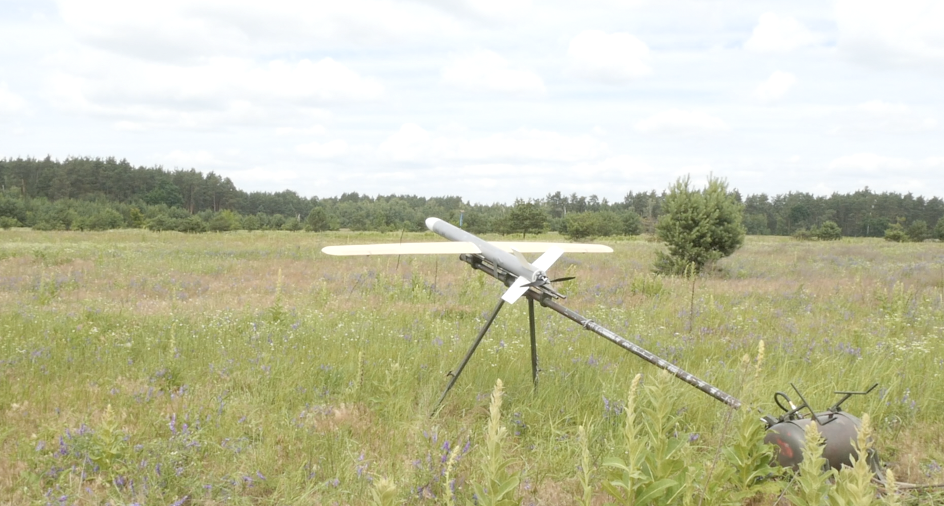
A key evolution in the Frontyr’s design is the shift from 3D-printed wings to cost-effective foam. This not only slashes production costs but also enhances field resilience. “We switched to an inexpensive foam, which is also great for storage as it doesn’t absorb moisture”, explained Andriy, a representative for the Frontyr team. “This gives us quality wings and superior performance characteristics during the final approach to the target”.
Beyond the hardware, the team’s core philosophy is centered on crew safety and mobility. They’ve designed the entire complex to be highly portable.
“Our concept is maximum mobility. A small minivan can carry two repeater drones and eight strike drones”, Andriy stated. “The enemy is actively hunting our drone crews, so we are increasing the operational distance to keep our people safe. That is a core part of our mission”.
With its performance validated by military use, the Frontyr team is now working to further reduce costs and fully integrate its advanced terminal guidance systems, proving that in modern warfare, the smartest solution is often the most adaptable and efficient one.
Source: MILITARNYI