LVIV, UKRAINE — There are no hypotheticals here. In a city synonymous with resilience, the global defense community gathered for a summit where the keynote speaker is the battlefield itself. Defense Tech Valley 2025 is not a showcase of what might be, but a stark exhibition of what is—of technology that has been tested, broken, and perfected under the relentless pressure of modern warfare. Its ethos is a blunt statement of fact: “What survives the battlefield shapes the future of Defense Tech”. Here, in the crucible of Europe’s largest conflict, the sluggish cycle of theoretical R&D has been replaced by the brutal, rapid evolution of combat-proven innovation.

For two days, Lviv became the global nexus for military leaders, venture capitalists, and engineers from over 40 countries. They gathered to witness firsthand how Ukraine has transformed from a recipient of military aid into a hyper-agile innovation hub, pioneering a new doctrine of warfare. The conversations, held between uniformed commanders and Silicon Valley investors, all revolved around a single, urgent truth: in the age of autonomous systems and pervasive electronic warfare, the cycle of innovation must now be measured in weeks, not years. “Adapt or disappear”, the summit’s tagline warns.
Here are five innovations showcased at the event that prove Ukraine and its allies are not just adapting—they are leading the charge.
The Autonomous Hunter: A Strike Drone That Sees Its Own Path
In the dense electronic fog of the modern battlefield, reliance on GPS is a fatal vulnerability. Russia’s sophisticated jamming capabilities have rendered many guided systems useless. In response, a powerful U.S.-Ukrainian collaboration has produced a solution that operates beyond the spectrum. American firm Shield AI and Ukraine’s Iron Belly unveiled the D4 long-range strike drone, an asset that redefines autonomous attack.
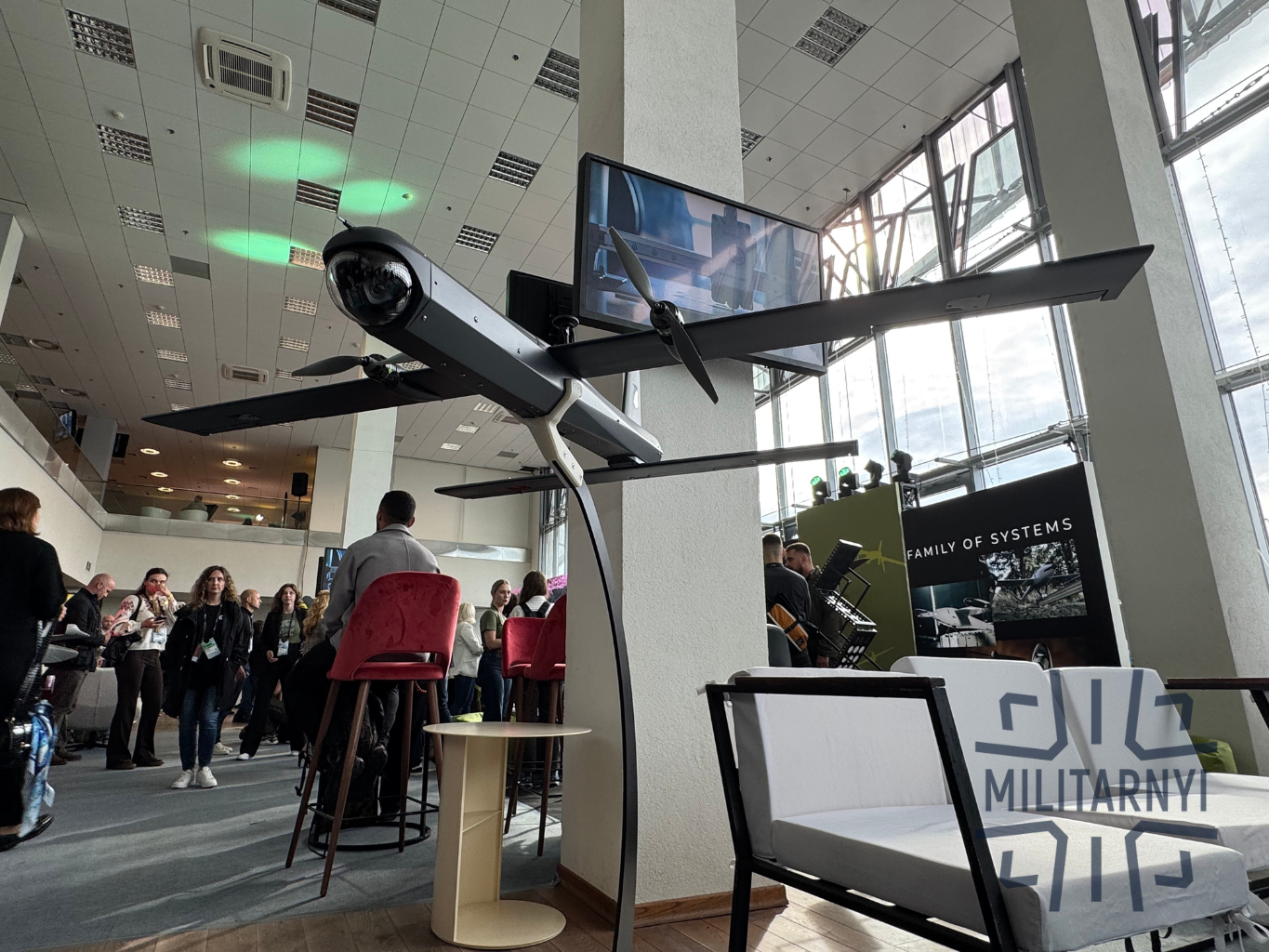
With a 100 km range and a 3 kg payload, the D4’s revolutionary feature is its reliance on optical navigation. It can be fed a target image, and from that point on, its onboard AI takes over, guiding it to the objective without external communication.
“We can upload a target image with its location, and the system will autonomously navigate using a combination of beacons and visual navigation”, explained Austin Howard of Shield AI. “At about 5-10 km out, the drone will lock onto the target. This means you don’t need GPS, you don’t need a link—it will find the target and strike it”.
After a month of successful field tests, the system is confirmed for frontline deployment, with production already scaling towards 1,000 units per month.
The All-Seeing Eye: Recon Drones for Any Environment
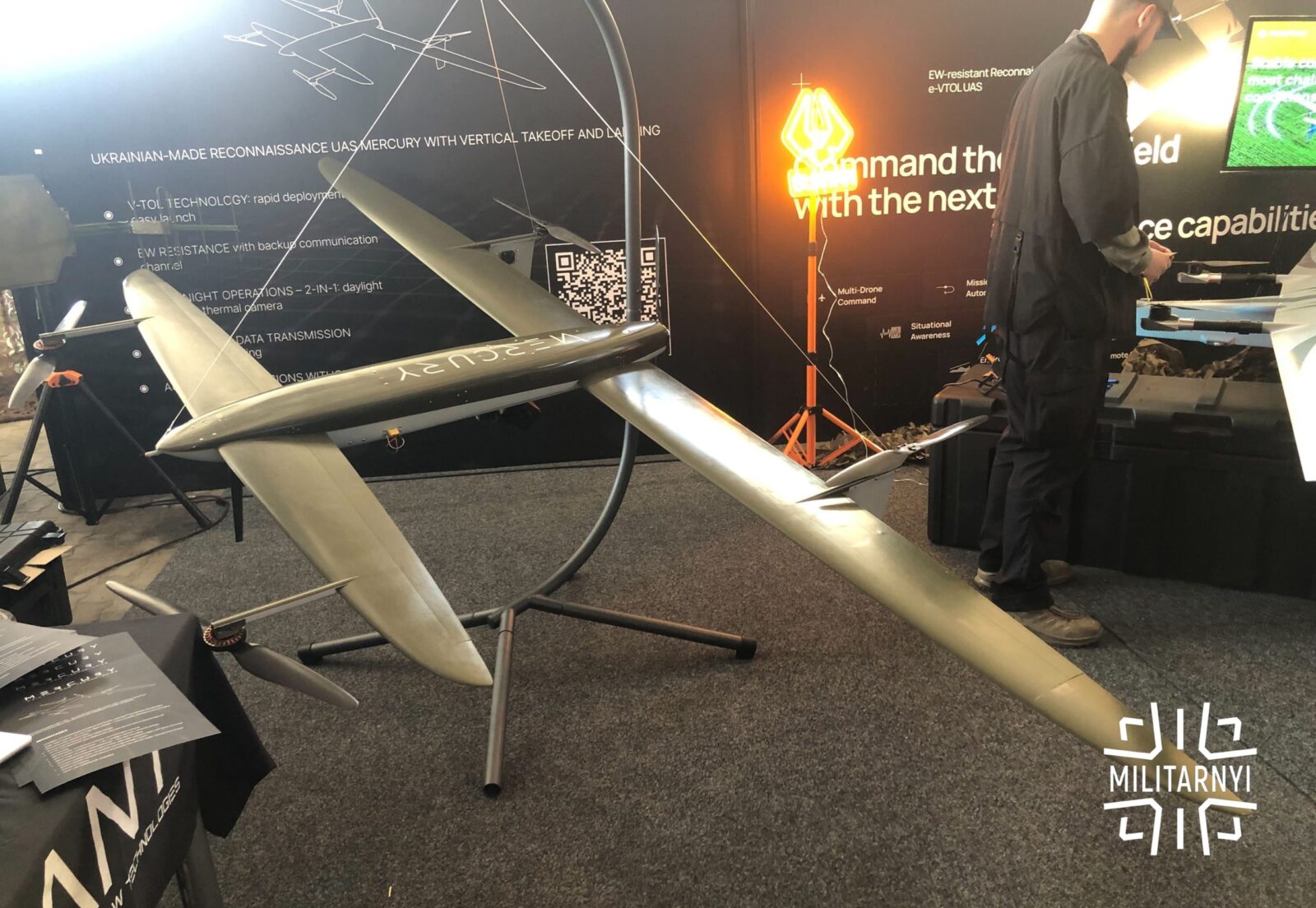
Versatility in reconnaissance is paramount. Answering this call, Aviation New Technologies presented the Mercury VTOL (Vertical Take-Off and Landing) drone. Designed for units operating where traditional catapult launchers are impossible, the entire system—two drones and a ground station—can be deployed by two operators in 15 minutes within a tiny 5×5 meter space. It boasts a three-hour endurance, a dual-channel optical module that can identify vehicles up to 20 km away, and an impressive operational resilience, capable of taking off in winds of up to 15 m/s. Crucially, it navigates using a trio of systems—satellite, inertial, and a network of ground-based radio beacons—ensuring it can return home even under heavy jamming.
“The ‘Mercury’ complex is already qualified in the NATO system and is being successfully supplied to the troops“, stated a company representative.
For more tactical, close-range missions, another startup showcased the SH-2 reconnaissance drone. This hand-launched, 10 kg aircraft offers a 60 km operational range, three hours of flight time, and a powerful gyro-stabilized camera with 30x optical zoom. Its primary advantage is its cost-effectiveness, achieved by intelligently adapting commercial components for military use, making sophisticated surveillance capabilities accessible at scale.
The Robotic Workhorse: Taking Humans Off the Frontline
The war’s brutal attrition has accelerated the push to automate logistics and medical evacuation. Trinity Robotics presented its answer: the “Konyk One” Unmanned Ground Vehicle (UGV). This rugged, 400 kg robot can carry a 300 kg payload over 40 km, ferrying supplies to entrenched positions or evacuating wounded soldiers.
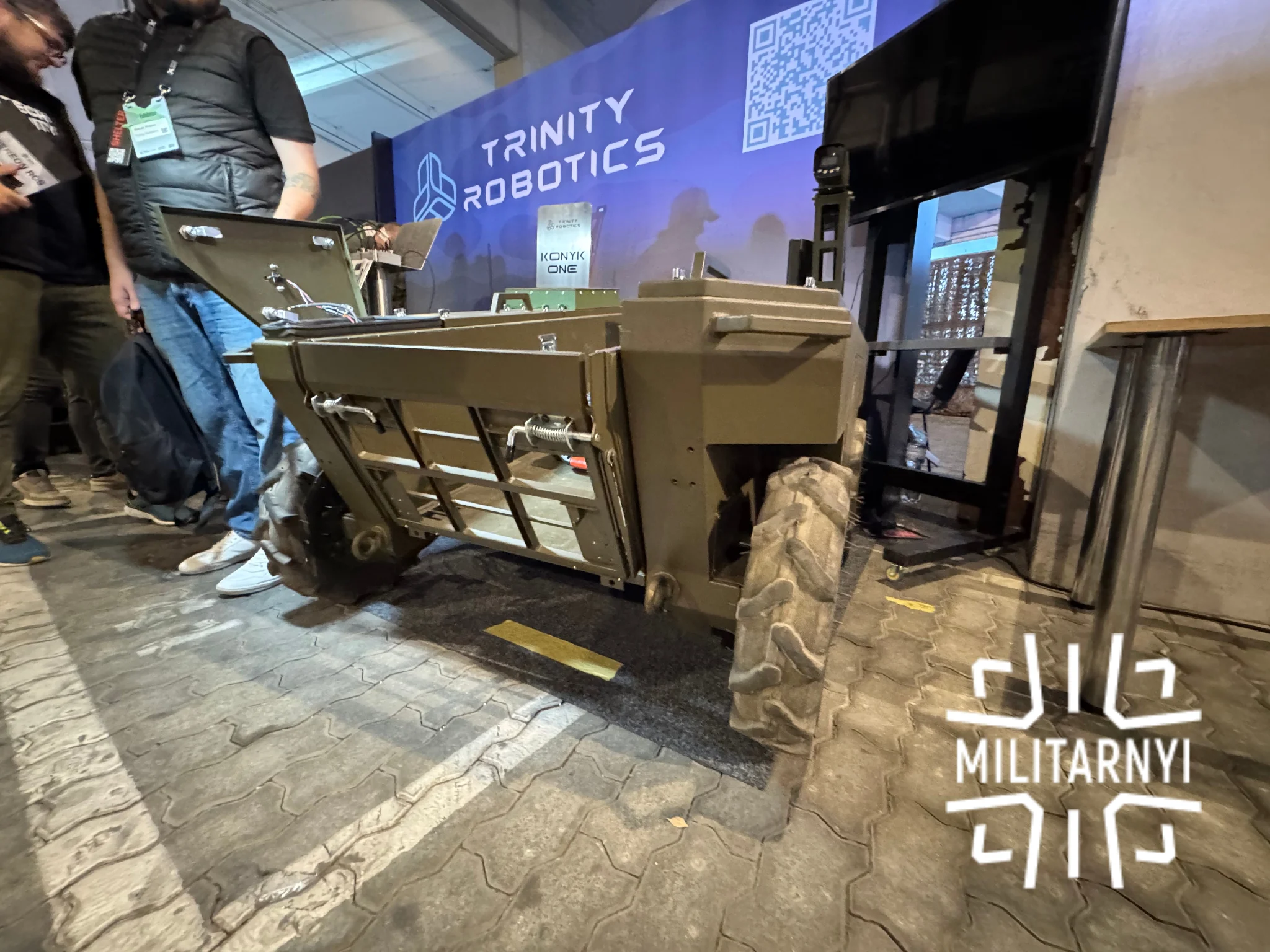
Already battle-tested on the Zaporizhzhia and Kharkiv fronts, the Konyk One is equipped with Starlink for satellite communication and runs on the domestically developed Jarvis onboard computer. Its most vital feature is a video-audio module, allowing a wounded soldier to communicate directly with the operator, a critical function for effective medical evacuation under fire. With production ramping up to 30 units per month, the Konyk One is set to become a familiar sight, saving lives by taking on the most dangerous missions.
The Engine of War: A Sovereign Supply Chain
The ubiquitous FPV drone has become a defining weapon of this war, but its effectiveness hinges on a fragile supply chain, largely dependent on China. Answering this strategic challenge, Ukrainian company Realgold presented its domestically produced electric motors for various FPV drone sizes, including high-performance interceptors.
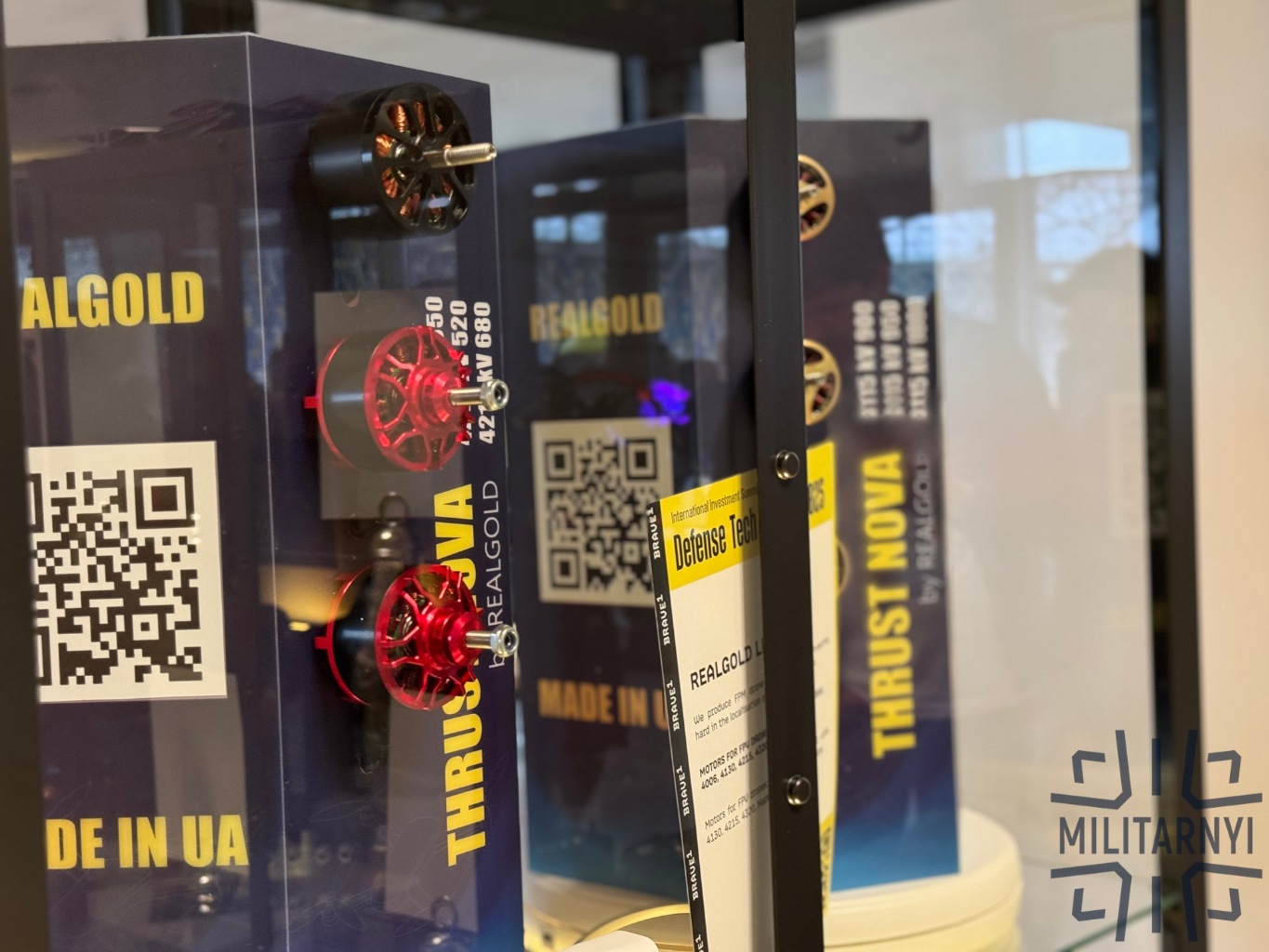
Since producing its first batch in January 2025, the company has scaled to an impressive 10,000 motors per month and claims it can expand to 100,000 “without significant investment” if the orders are there. However, Realgold faces a paradoxical challenge: domestic tax laws make its components more expensive than tariff-free Chinese imports.
“Imported components for drones have preferences: they are brought in for military use without customs duties and VAT… Thus, the Ukrainian manufacturer effectively loses to a conditional Chinese company“, a company spokesperson lamented.
Despite this, the strategic imperative is clear. The goal is to achieve 70% localization, moving beyond simple assembly to true domestic manufacturing.
“If we want to be powerful in the future, we need our own production, our own R&D”, the representative concluded. “Of course, it’s easier to buy something on AliExpress… but that won’t provide experience, knowledge, and won’t keep the money here“.
This drive for sovereign capability is perhaps the most significant long-term development on display, signaling Ukraine’s ambition to become a permanent, self-sufficient player in the global defense industry. The technologies showcased at Defense Tech Valley are more than just hardware; they are artifacts of a nation’s fierce will to survive and innovate under unimaginable pressure. They are lessons written in code, composite, and steel—lessons the world has come to Lviv to learn.