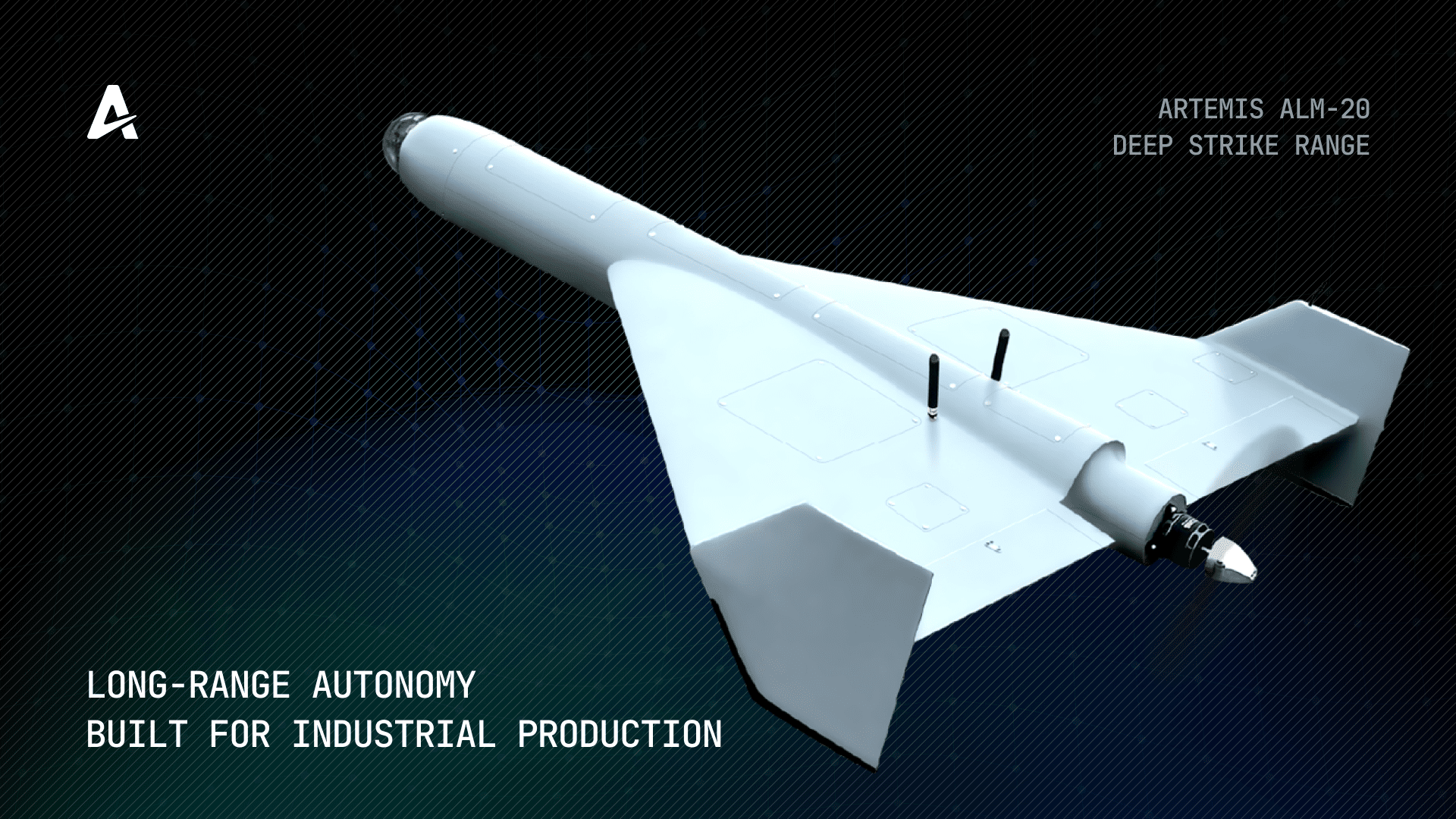
American UAV software company Auterion, in a close partnership with an undisclosed Ukrainian firm, has officially announced the successful development and combat testing of the Artemis ALM-20, a long-range kamikaze drone. According to reports from Defense Express, this new system boasts a range of 1,600 kilometers, carries a 45 kg warhead, and utilizes advanced AI for terminal guidance, making it a formidable new asset.
The core of the Artemis drone is its advanced navigation and targeting system, powered by Auterion’s Skynode N onboard computer. The company states that this technology “allows the drone to navigate and strike targets even during satellite navigation failures” and “ensures the highest precision in the final phase of flight”. This capability is critical for operating in environments with heavy electronic warfare, a constant reality in the current conflict.
Auterion confirmed that the project has completed a full cycle of demanding trials, which “included ground launch, GPS and non-GPS navigation, long-range transit, and ground detonation”—a statement widely interpreted as confirmation of successful strikes on Russian territory.
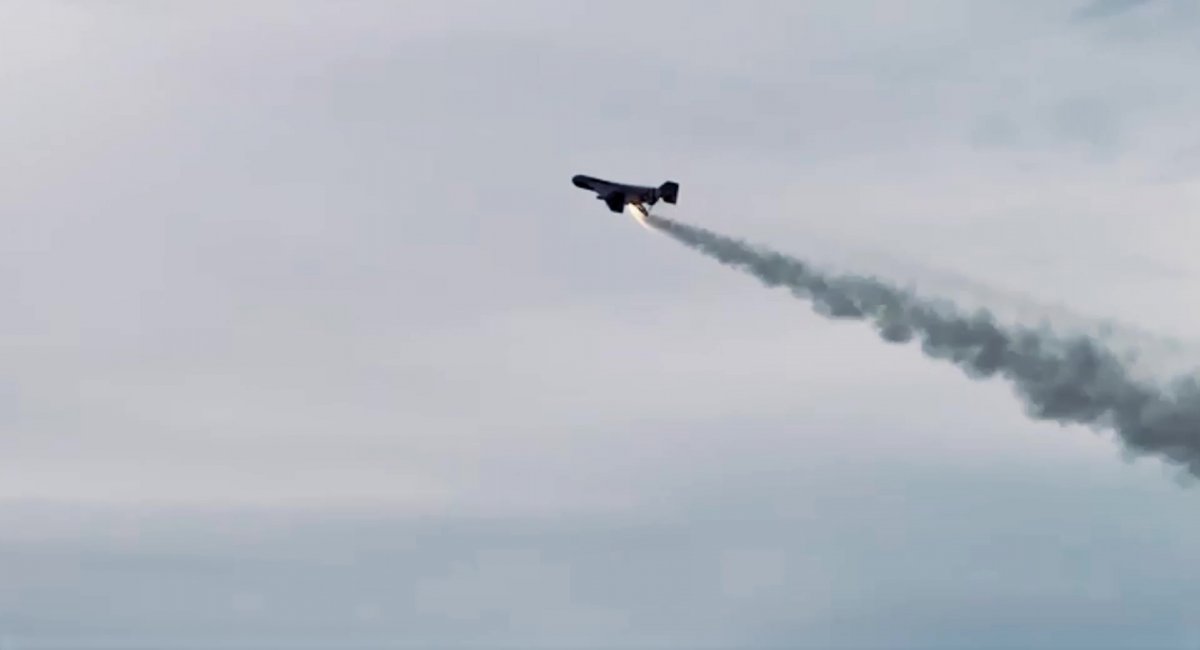
Further evidence emerged when Auterion released a video showcasing the drone’s capabilities. The footage clarifies several key details. The Artemis ALM-20 is launched via a solid-fuel rocket booster and is powered by an internal combustion engine, which is necessary for its extensive range. This contradicts an earlier official image that depicted an electric motor, suggesting that image was of a smaller, shorter-range variant.
The video also provided a glimpse of the operator’s interface, revealing a “GPS+VIS” mode, which confirms the system’s ability to use visual navigation to lock onto targets, guided by AI. This makes the drone resilient to GPS jamming. The interface also showed a drone completing an attack after a flight time of 3 hours and 44 minutes, reaching speeds of up to 193 km/h (53.8 m/s) in its terminal dive.
The Artemis ALM-20 has already been identified in action. Its distinctive forward canards (small horizontal wings near the nose) match those seen on drones in videos filmed by Russians during attacks in the Moscow region in March 2025 and on the “AOMZ” factory in Azov in July 2025.
This advanced system appears to be the culmination of an iterative development process. A smaller, similar-looking drone, later identified as the UAS SETH, was first seen publicly in December 2024. By March, the 12th “Azov” Special Purpose Brigade showcased the UAS SETH in combat, highlighting its fully autonomous capabilities. Auterion’s official statement notes, “government specialists approved the [Artemis] program after operational flight tests in Ukraine”, suggesting the smaller SETH drone served as a crucial real-world testbed for the technology before being scaled up into the long-range ALM-20.
The project is now moving into a new, ambitious phase. Auterion announced it is “transitioning to a scaling phase with the U.S. Department of Defense and other partners, aimed at joint production on a large scale”. Production facilities are reportedly being established in Ukraine, the United States, and Germany, signaling a significant international effort to mass-produce this highly effective, next-generation strike drone. This development follows the earlier selection of Ukrainian companies for the U.S. Army’s Project Artemis, a topic previously covered by TechUkraine.