As the war in Ukraine evolves into a high-stakes laboratory for autonomous systems, a critical shift is occurring: Electronic Warfare (EW) is losing its absolute dominance. With the rise of fiber-optic-controlled drones and inertial guidance systems, jamming is no longer a silver bullet. The industry’s gaze is shifting toward a more definitive solution — kinetic interception.
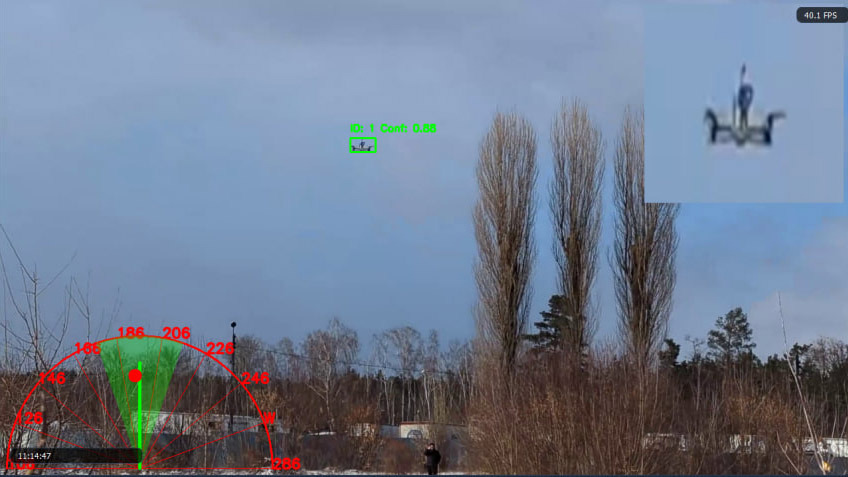
Ukrainian tech company I-SEE is at the forefront of this transition. Initially known for its intelligent detection systems, the company has unveiled an AI-driven complex designed to serve as the “universal core” for a new generation of Active Protection Systems (APS).
Edge AI: Intelligence Without the Tether
The core competitive advantage of the I-SEE system lies in its hardware agnosticism. By leveraging Edge AI and advanced computer vision, the software can transform virtually any optical sensor into a high-precision smart tracker.
Crucially, all video processing occurs “on the board”. This local processing eliminates latency and the need for an internet connection — two factors that are often the difference between a successful interception and a direct hit.
From Detection to Automated Interception
The I-SEE ecosystem is designed for rapid deployment across three primary high-stakes scenarios:
- Infrastructure & Logistics: Integration with existing IP and PTZ cameras to create autonomous security perimeters around warehouses and command posts.
- Mobile Armor Defense: Mounting on pickups, trucks, or Armored Personnel Carriers (APCs) to track threats while in high-speed motion.
- Air-to-Air Combat: Powering Ukrainian interceptor drones with the ability to automatically detect, lock onto, and track enemy UAVs.
One of the most impressive technical feats is the system’s ability to calculate a target’s velocity and trajectory vector with surgical precision. This allows for the full automation of net-gun systems. The AI independently assesses the distance, calculates the lead, and fires a net to neutralize incoming FPV or “drop” drones without any human intervention.
The Vision: An Autonomous “Dome” for Heavy Armor
The logical endgame for I-SEE is the development of a full-scale Anti-Drone APS. The team is currently engineering its own automated turret designed to create a kinetic “dome” over individual vehicles or tactical positions.
“Detection is only the first stage. When the enemy uses fiber-optics, EW becomes irrelevant. The only answer left is kinetic interception”, the company stated in a recent release.
By syncing the I-SEE AI-tracker with a high-speed robotic turret, the company aims to eliminate the “human factor” — the inevitable delay caused by stress or fatigue in a combat environment.
The Strategic Payoff: Restoring the Maneuver
The successful deployment of a reliable, AI-driven APS could be a strategic turning point, effectively neutralizing the absolute dominance that FPV drones currently hold over the battlefield. By providing a reliable kinetic shield against loitering munitions, this technology could restore the operational freedom of mechanized and tank units. In an era where armor has been forced into hiding, I-SEE’s “autonomous dome” offers a path for heavy brigades to return to high-intensity maneuver warfare, protected by a layer of security that digital jamming can no longer guarantee.
Source: Militarnyi