The Ukrainian defense tech landscape is moving beyond the “FPV-only” era. As the theater of operations evolves, manufacturers are forced to transition from rapid assembly to deep-tech engineering and global supply chain management. Vyriy, a frontline leader in UAV production, has unveiled a comprehensive 2026 strategy that shifts the focus from mass-market attrition to specialized, high-margin niches and international expansion.

Visualized through the synergy of TechUkraine Editorial & Generative AI
The Strategic Pivot: Filling the “Middle Mile”
While the market for standard FPV drones has become oversaturated and price-sensitive, Vyriy is pivoting toward unaddressed operational gaps. CEO Oleksiy Bobenko identifies the 40–100 km range as the critical new frontier.
“We are concentrating on niches that aren’t closed by anyone yet”, Bobenko stated. “In 2026, our main effort isn’t on standard FPVs, but on long-range reconnaissance, strike wings, and motherships”.
This shift is highlighted by a new operational record: a standard Vyriy multi-rotor recently achieved a strike at a range of 80 km, pushing the theoretical limits of the platform to nearly 95 km.
European M&A: Buying the Supply Chain
Perhaps the most significant business revelation is Vyriy’s move into international M&A. To mitigate the risks of missile strikes on domestic facilities and to bypass logistical bottlenecks, the company is finalizing the acquisition of 70–80% stakes in two European component manufacturers.
This strategy serves three purposes:
Logistical Efficiency: Shipping components from China to the EU is significantly faster and more predictable than direct routes to Ukraine.
R&D Access: Leveraging European university clusters and material science expertise to improve hardware performance.
Risk Diversification: Establishing production hubs in countries with existing security agreements (7 countries currently in focus) to ensure a “missile-proof” supply chain.
The Silicon Valley Collision: Fiber Optics and the AI Boom
In a classic example of globalized market interference, Ukraine’s “fiber optic drone” trend has hit a wall—not due to the war, but because of Google and the AI boom. The massive expansion of data centers has triggered a global shortage of high-grade fiber (A2 class), driving prices from $4 to over $20 (and even $30) per kilometer.
For Vyriy, this has turned existing state contracts into a challenge of unit economics. The company is now re-engineering its platforms to balance the high-fidelity benefits of fiber optics with the cost-efficiency of radio-link systems and Starlink integration for “mothership” platforms like the Veresen.
The 2026 Product Ecosystem
Vyriy’s roadmap replaces commercial off-the-shelf solutions with specialized indigenous platforms:
Slavic: A dedicated reconnaissance UAV designed to replace the DJI Mavic. It features a 2-hour flight target and a proprietary beacon system for navigation in GPS-denied environments.
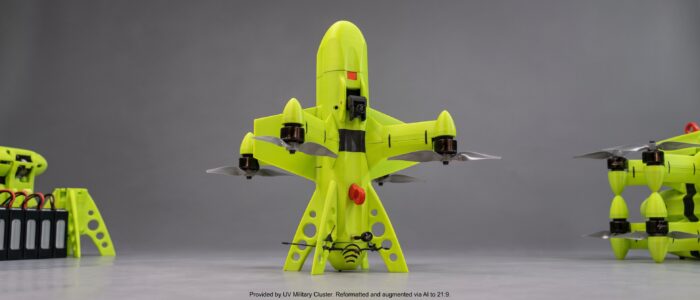
Veresen: A “mothership” carrier drone capable of deploying two FPVs at 50 km ranges, functioning as a mobile relay and strike coordinator.
Sokil: A long-range reconnaissance wing with 3-hour endurance and a $4,000 price point, designed for high-risk intelligence gathering where expensive Western systems are too “precious” to lose.
Dzhankoi: An upgraded ground robotic platform (UGV) with a 500 kg payload capacity, now being standardized for medical evacuation and “logistics-as-a-service” for frontline units.
Regulatory Shifts: The VAT Breakthrough
Bobenko also highlighted a major regulatory win for the domestic industry. New changes to the tax code now allow manufacturers of Ukrainian components to reclaim VAT within approximately one week. This 20% “efficiency boost” makes domestic component production finally competitive with Chinese imports, though Bobenko warns that the 25% margin cap on government contracts remains a primary hurdle to market-driven innovation.
Professionalization and the Talent War
Vyriy is no longer a volunteer initiative; it is a corporate machine. With 110 unique vacancies and salaries reaching 500,000 UAH per month, the company is directly competing with the Tier-1 IT sector. This influx of professional management and engineering talent is the final ingredient in Vyriy’s plan to stabilize production and transition into a global defense contractor.
Source: Militarnyi