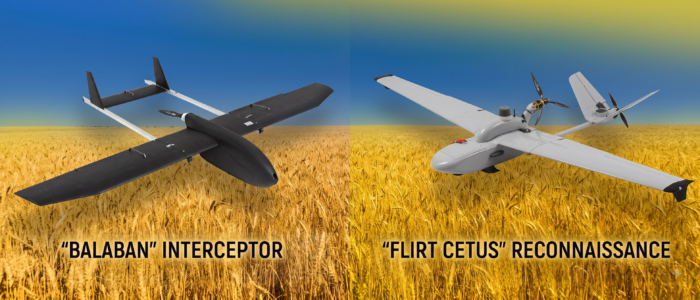
This August, at Scandinavia’s largest defense exhibition, DALO Industry Days, Ukraine presented a clear, unified message to its international partners. With the debut of its national brand, ZBROYA (Weaponry), the country showcased a range of battle-proven technologies, aiming to pivot the conversation from aid to active industrial collaboration and co-development.
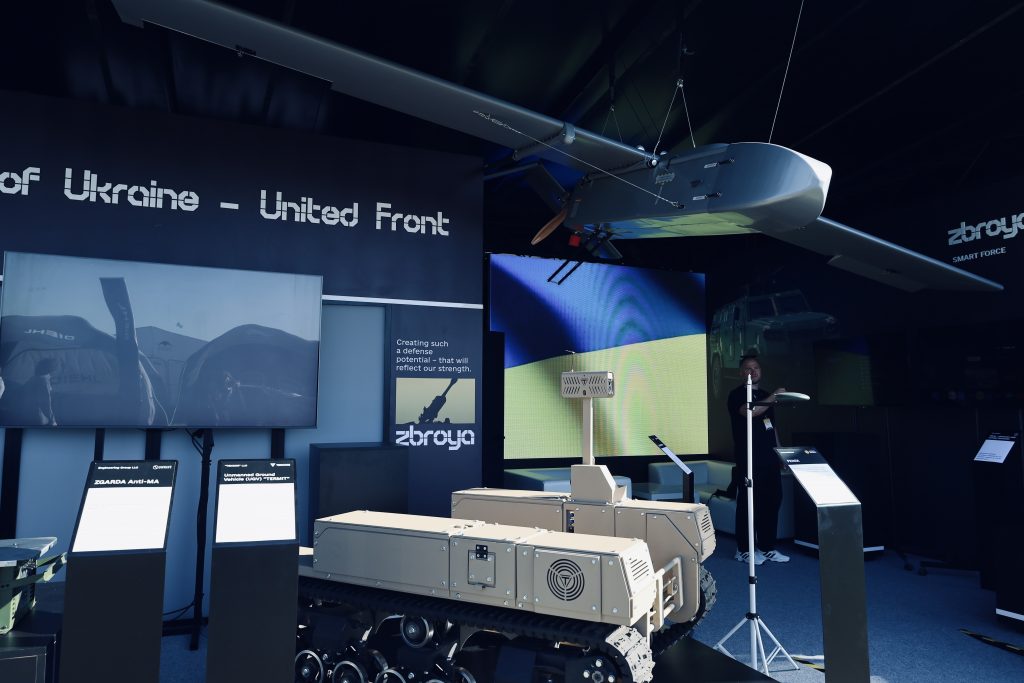
For the first time, a Ukrainian national pavilion provided a focused look at the country’s rapidly evolving defense-tech sector. The choice of Denmark as the venue was strategic, building on a robust partnership that offers a practical model for the future of European defense cooperation.
The Danish Model: A Focus on Direct Investment
Denmark has become one of Ukraine’s key allies, committing over €7 billion in military support since 2022. More importantly, it has pioneered the “Danish Model”—a strategy of directly financing Ukrainian domestic production.
This approach has already seen €597 million mobilized to boost local manufacturing. A prime example is the €50 million contract for 18 Ukrainian-made Bohdana self-propelled howitzers, which were delivered to the front lines within two months. The ZBROYA initiative at DALO aimed to build on this success, connecting Danish and other international partners directly with the Ukrainian companies that are getting the job done.
Setting the Framework for Cooperation
The event’s focus on practical steps was established at the Danish-Ukrainian Defence Seminar preceding the exhibition. Former NATO Secretary General Anders Fogh Rasmussen noted that investing in Ukraine’s defense industry has a dual benefit. He explained that while the technology meets Ukraine’s immediate needs, it also strengthens the entire NATO industrial base.
Ihor Fedirko, CEO of The Ukrainian Council of Defence Industry, framed the Danish-Ukrainian partnership as a combination of Denmark’s high-tech ecosystem and Ukraine’s “battle-tested” innovation. He stated that the key is “to translate political decisions into production: fast contracts, joint lines, and standardization and certification for the needs of NATO and the EU”. According to Fedirko, Ukrainian solutions—from long-range UAVs to anti-tank and anti-ship systems—go through a complete cycle on the front line, which “provides the pace of modernization needed by both Ukraine and its allies”.
A Look at the Tech Inside the ZBROYA Pavilion
The pavilion offered a direct line to Ukrainian engineers and their field-tested products. The lineup demonstrated a mature and diverse ecosystem, from unmanned systems to advanced electronic warfare.
- UAS and Recon:
- DEVIRO presented its well-known Leleka-100M2 recon drone and the Bulava strike UAV, a combination proven to be effective under heavy EW conditions.
- Athlon Avia showed its Furia UAS, a trusted platform for artillery spotting since 2014.
- Fire Point displayed its FP-1 strike drone, the system used for a significant number of Ukraine’s long-range attacks on Russian oil refineries and military infrastructure.
- Rise Technologies Ukraine presented its Yautja reconnaissance complex, designed for deep recon missions (50+ km) with secure communications and navigation in GNSS-denied environments.
- Unmanned Ground Vehicles (UGVs):
- Tencore brought its TerMIT UGV, a system already deployed in large numbers and designed for scalable, NATO-standard operations.
- Ark Robotics demoed its Frontier System, which uses AI to coordinate multiple robotic platforms, reducing operator workload.
- UGVrobotics offered a live interactive demo, allowing attendees to pilot its “Lut” (Fury) UGV in Ukraine directly from the exhibition floor via satellite link.
- Electronic Warfare (EW) and Sensors:
- Unwave showcased its EW modules built entirely with NATO-sourced components and its “Pastka” (Trap) infrastructure protection system.
- Octava Defence presented its Fenek acoustic detection system, a sensor network that identifies and tracks both air and ground threats in real-time.
- Osavul demonstrated its AI solution for analyzing social media to detect and counter information threats, a tool developed on the front lines of the hybrid war.
- Engineering Group displayed its front-line-proven mobile EW solutions, noted for their effectiveness against advanced drone threats.
- FPV and Training:
- TAF Industries, a major FPV producer, highlighted its scale—with 3.7 million “Kolibri” drones delivered in 2024 and a production capacity of over 80,000 per month.
- Twist Robotics presented its Obriy UAV Combat Simulator, a tool for training operators and testing tactics in a safe, virtual environment.
The ZBROYA initiative at DALO Industry Days was less about spectacle and more about business. It sent a clear signal that Ukraine’s defense industry is operational, innovative, and open for partnership. The focus now is on building sustainable joint ventures, localizing production, and integrating Ukraine’s battle-tested solutions into the broader European security architecture.
Source: MILITARNYI