From breaking speed records at 400 km/h to rebuilding the industrial supply chain from scratch: Motor-G isn’t just competing with Chinese imports—it’s creating a new European standard for military propulsion.

The war in Ukraine has become the ultimate accelerator for defense innovation. But beyond the headlines of drone strikes lies a deeper, more critical battle: the fight for technological independence. At the forefront of this shift is Motor-G, a Ukrainian manufacturer that has managed to do what many European defense giants are still planning—create a scalable, combat-proven alternative to Chinese hardware.
While the company captures global attention with kinetic breakthroughs, its industrial strategy remains its most potent weapon.
The Interceptor Breakthrough: 400 km/h
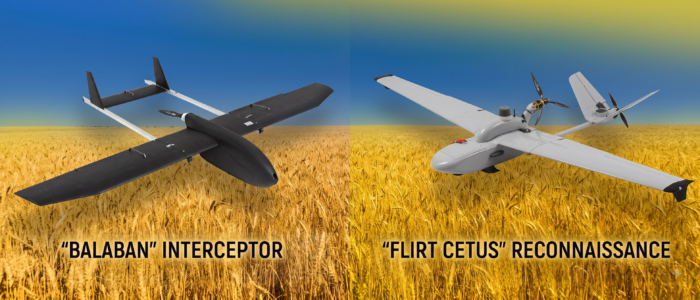
The most visible result of Motor-G’s engineering is speed. As confirmed by the Ministry of Digital Transformation and the Brave1 cluster, a new Ukrainian interceptor drone powered by Motor-G engines has achieved a top speed of 400 km/h.
This is not a theoretical metric. It represents a tactical shift in air defense, enabling Ukrainian operators to chase down and neutralize high-speed enemy reconnaissance UAVs that were previously untouchable by standard FPVs. It is the kinetic proof that domestic technology can outperform mass-market solutions.
The Industrial War: Competing with the “World’s Factory”
However, the company’s CEO, Oleksii Hrebin, sees the battlefield differently. For him, the real challenge is supply chain sovereignty. In a market flooded with cheap imports, Motor-G has carved out a position as the largest drone motor manufacturer in Ukraine, partnering with over 100 local UAV producers.
Hrebin is realistic about the competition.
“Our biggest competitors are Chinese manufacturers. There is a war in Ukraine, and war requires a lot of motors, quickly and cheaply. Therefore, Chinese motors are the most attractive for Ukrainian drone manufacturers”, Hrebin explains. “But with our products, we offer the highest quality alternative on the market and hope to replace Chinese motors in the coming years”.
The “Motor Without China” Doctrine
The company’s ambition goes beyond simple assembly. Hrebin outlines a strategic roadmap for what he calls a “motor without China”—a propulsion unit completely free of components from the PRC.
Currently, Motor-G has reached an 80% localization rate. The remaining challenge lies in specific components like magnets and bearings, which are globally sourced from China. But Motor-G is solving this by building an entire ecosystem from the ground up.
“Our goal is not just 100% localization, but 100% absence of Chinese components,” Hrebin emphasizes. “We have already created a market for CNC parts, bearings, and copper wire. Previously, no one produced stators in Ukraine. Stator is a key element of the motor. Now, we have manufacturers for them”.
By creating steady demand, Motor-G has enabled other Ukrainian tech companies to launch production lines for copper wire, silicon cabling, and precision parts, effectively resurrecting complex engineering sectors in the country.
Europe’s Awakening
This resilience has not gone unnoticed in the EU. European defense companies, increasingly wary of supply chain vulnerabilities and Chinese geopolitical leverage, are looking to Ukraine for solutions. They need components that adhere to NATO standards but possess the rugged reliability that only combat can forge.
“European companies want Ukrainian motors because they are an alternative to China, they work in combat conditions, are proven, and of high quality”, says Hrebin.
He notes that conversations about joint ventures are already underway. The logic is simple: Europe needs localization for its own security, and Ukraine has the technology and the testing grounds to provide it.
A Mature Ecosystem
What started as a response to urgent military needs has evolved into a mature industrial player. Motor-G now operates a three-tier testing system—from laboratory benchmarks to small-batch field tests and finally, mass deployment with military units.
With a plan to reach 90% localization in the near future and the continued scaling of production to lower costs, Motor-G is proving that the future of European defense tech is being written in Kyiv.
Source: MILITARNYI